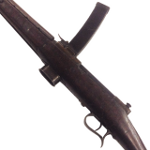
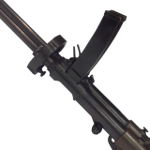
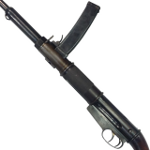
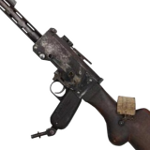
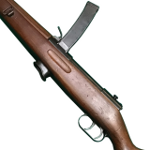
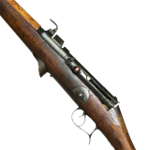
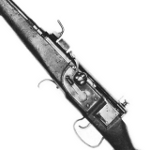
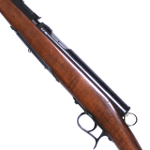
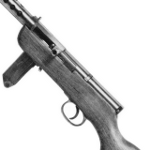
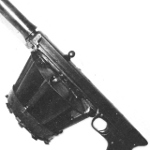
Ansaldo Crocetti submachine gun
[IT] Moschetto Automatico Crocetti
Since
the end of 1916, the Italian Army had been interested in adopting a
submachine gun for the Aviation Corps after observing the
demonstration of Major Revelli's Carabinetta Automatica O.V.P.
Demand for a similar weapon to be issued in the capacity of an
infantry weapon had increased by 1918, by which point several more
submachine gun designs, known collectively as moschetti
automatici ('automatic muskets'), had been developed by
parties including Fabbrica d'Armi Pietro Beretta, Amerigo
Cei-Rigotti,
SIAI Savoia, and
Alberto Neri. All of
these guns were made by converting the Villar Perosa into a
single-barreled weapon with a wooden buttstock. However in August
1918, Enrico Crocetti secured a patent protecting a new type of
submachine gun that was not based on the Villar Perosa, but was
instead an original design. This gun, developed at the Gio Ansaldo
& C. company of Genoa, was known interchangeably as the Moschetto
Automatico Crocetti or Moschetto
Automatico Ansaldo.
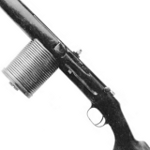
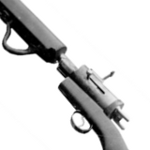
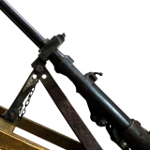
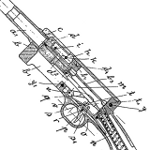
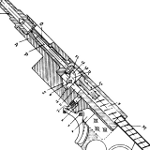
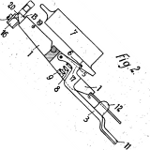
Though no physical examination of the Ansaldo Crocetti submachine gun can be undertaken, as there are no known surviving examples, the patent drawing reveals that the gun was a quite advanced for its time, operating on a lever-delayed blowback action in which the bolt is built into two sections, with a pivoting lever dividing them. The lever lays flat when the bolt is in the rear (open) position, but when the bolt comes forward, the lever drops into a recess cut into the forward part of the bolt path which forces a rotation upon the lever. The lever then pivots into a vertical position and pushes the firing pin forward so that it protrudes through the bolt face and strikes the chambered cartridge. The blowback force generated by the shot pushes the lever out of the recess and unlocks the bolt. This action can be compared to the later Király designs which appeared in Hungary in the 1930s and 40s. Though no magazine is illustrated in the drawings, an overhead feed opening indicates that the Ansaldo Crocetti submachine gun was probably designed to feed from 25-round Villar Perosa magazines.
The Italian Army's Technical Office ordered 3 Ansaldo Crocetti submachine guns on the 4th of October 1918, after the Revelli-Beretta system had already been adopted. It is known that comparative trials between the Revelli-Beretta and Ansaldo Crocetti guns were held late in 1918, and a report issued in December appears to indicate that the Ansaldo gun was actually preferred. However, no action was taken with the Ansaldo Crocetti submachine gun as the Revelli-Beretta had been newly introduced into service and there was no great demand for an additional moschetto automatico. The Ansaldo Crocetti was again retested in the early 1920s, though only in the capacity of a test control during Italian trials of a new intermediate rifle cartridge. After the First World War, Enrico Crocetti left the Ansaldo company and went to Mexico to work as a consultant at their government arsenals.
Though no physical examination of the Ansaldo Crocetti submachine gun can be undertaken, as there are no known surviving examples, the patent drawing reveals that the gun was a quite advanced for its time, operating on a lever-delayed blowback action in which the bolt is built into two sections, with a pivoting lever dividing them. The lever lays flat when the bolt is in the rear (open) position, but when the bolt comes forward, the lever drops into a recess cut into the forward part of the bolt path which forces a rotation upon the lever. The lever then pivots into a vertical position and pushes the firing pin forward so that it protrudes through the bolt face and strikes the chambered cartridge. The blowback force generated by the shot pushes the lever out of the recess and unlocks the bolt. This action can be compared to the later Király designs which appeared in Hungary in the 1930s and 40s. Though no magazine is illustrated in the drawings, an overhead feed opening indicates that the Ansaldo Crocetti submachine gun was probably designed to feed from 25-round Villar Perosa magazines.
The Italian Army's Technical Office ordered 3 Ansaldo Crocetti submachine guns on the 4th of October 1918, after the Revelli-Beretta system had already been adopted. It is known that comparative trials between the Revelli-Beretta and Ansaldo Crocetti guns were held late in 1918, and a report issued in December appears to indicate that the Ansaldo gun was actually preferred. However, no action was taken with the Ansaldo Crocetti submachine gun as the Revelli-Beretta had been newly introduced into service and there was no great demand for an additional moschetto automatico. The Ansaldo Crocetti was again retested in the early 1920s, though only in the capacity of a test control during Italian trials of a new intermediate rifle cartridge. After the First World War, Enrico Crocetti left the Ansaldo company and went to Mexico to work as a consultant at their government arsenals.
Resources used:
- Filippo Cappellano, 'La Genesi del Moschetto Automatico Italiano', Storia Militare, No. 194 (November 2009)
- Vittorio Balzi, I Mitra Italiani 1915 - 1991 (Florence: Editoriale Olimpia, 1992)
- Vincenzo Gallinari, L'Esercito
Italanio nel Primo Dopoguerra 1918 - 1920 (Roma: Ufficio Storico
SME, 1980)
This article is part of a series on Submachine Guns of the First World War