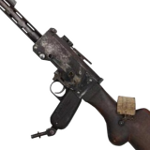
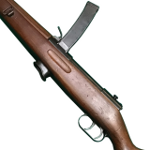
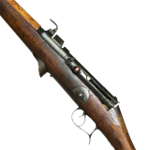
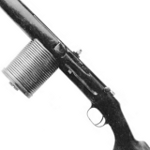
Revelli O.V.P. submachine gun
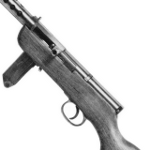
[IT] Carabinetta Automatica O.V.P.
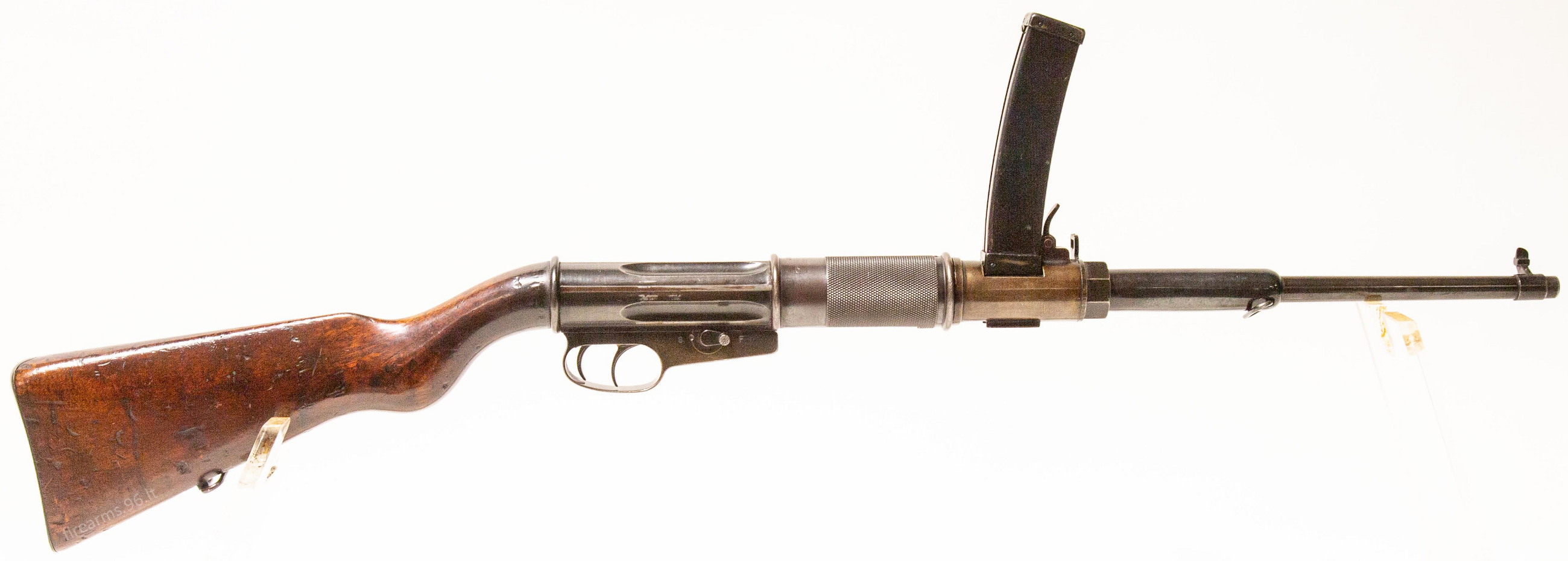
(Author's photo via Royal Armouries Collection)
Internally, the Villar Perosa action was unchanged, operating on an inertia-based locking system in which the bolt sat in a 45° incline in the forward position. When the bolt came back into the rear position, it would be carried out of the incline, and then fall back into the incline upon returning to the breech. The incline forced a small rotation, and thus delay, in the bolt which was intended to ensure that the bolt would be fully closed before the firing pin struck. However, as with the "Blish" lock of the later Thompson gun, this inertial-type bolt delay had no appreciable effect and was essentially a gimmick. The fire rate produced by the Villar Perosa action was exceptionally high, at around 900 - 1,000 rounds per minute.
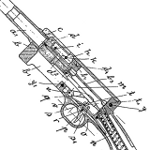
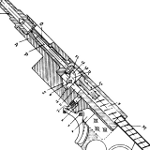
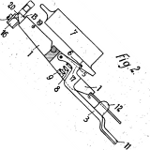
The O.V.P. submachine gun was trialed again in February of 1917 and patented the following month in March. The patent sketch depicts a few design features that would not be present in the production model, including the placement of the magazine feed on the underside of the receiver rather than the top (as per the Villar Perosa), and centrally-mounted iron sights which would be replaced in the final model with offset, left-mounted sights. It is possible that this upward-feeding magazine arrangement was abandoned because the Villar Perosa magazines performed better with gravity assistance. It is not known whether the prototype tested in 1916 and early 1917 was built with the unusual features seen on the patent sketch, but in any case the final production model was not.
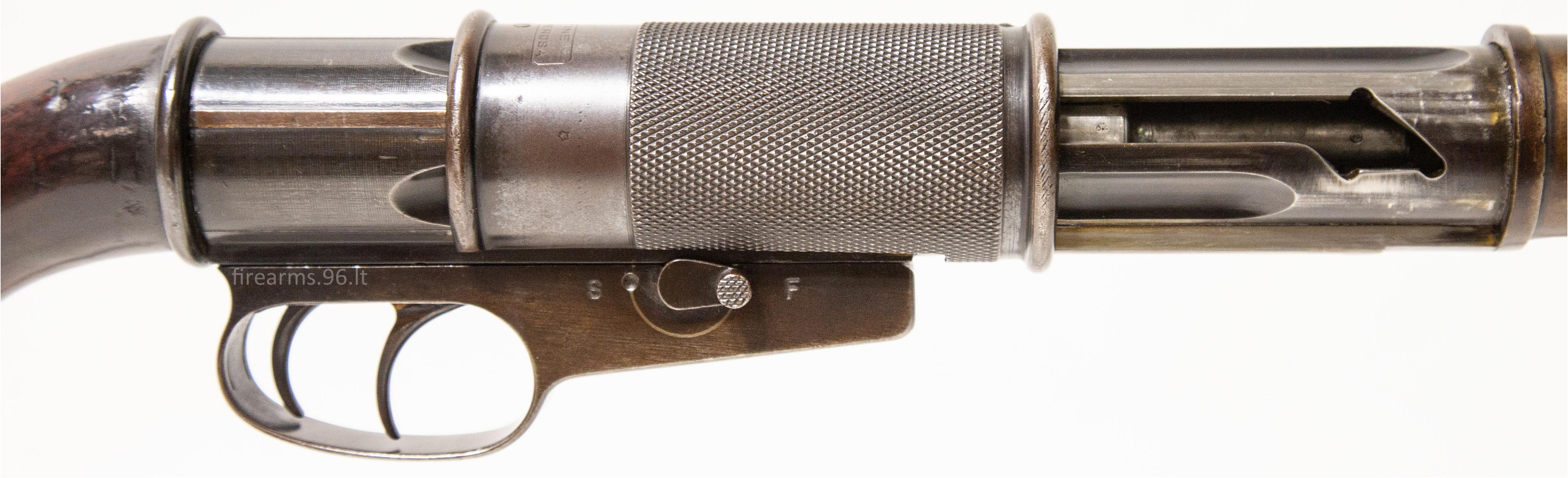
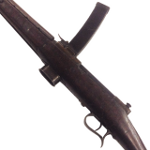
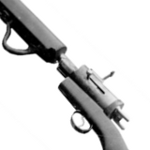
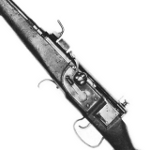
The Carabinetta Automatica O.V.P., cocked with bolt open. The cocking sleeve does not move with the bolt
and is only shown open here for demonstrative purposes; it would actually be closed before firing.
(Author's photo via Royal Armouries Collection)
The requirement for a weapon of this type was decided by the Aviation Corps upon experiencing difficulty requisitioning a consistent supply of Mauser C96 pistols, which were at that time the standard aviator's sidearm. Due to the war with Germany, the Italian government could not place further orders of C96s from the Mauser factory. Intermittent purchases of C96 copies from other countries, including China, managed to ward off the adoption of the O.V.P. submachine gun until May 1918, when it officially came into service as the C96's replacement. Its adoption was also approved by the Naval Aviation Corps. Some 500 O.V.P. submachine guns (recorded as Carabine .V.P.) were delivered to the Aviation Corps in 1918. It is generally believed by Italian sources that these were the only such guns ever produced. These guns were distributed to pilots and observers in the last year of the war; a known user of the O.V.P. submachine gun was the famous aviator Antonio Locatelli, who carried one during observation flights in late 1918.
Contrary to popular belief, the O.V.P. submachine gun was not intended for infantry assault units like the Arditi corps. The regular army held their own separate submachine gun trials which compared designs by Beretta, Ansaldo, SIAI Savoia, Cei-Rigotti, and A.N. The Beretta gun was adopted, with Colonel Revelli's personal approval, in September 1918 as the Moschetto Automatico Revelli-Beretta Mod. 1915 (commonly known as the 'Beretta Model 1918') - however it was ultimately only adopted in semi-automatic form and was therefore not a true submachine gun. Due to the adoption of the Revelli-Beretta, there was no requirement for the O.V.P. submachine gun in infantry service. Despite this, it is reported that a small batch of O.V.P. submachine guns were used in terrestrial combat by an Arditi battalion who fought at Mofenera in September, likely in a trial capacity, though the details are currently yet to be verified.
After the war, the immediate requirement for the O.V.P. submachine gun disappeared and production at Officine di Villar Perosa likely ceased. O.V.P. split with Fiat to become an independent company in 1919 and suspended armaments manufacture. A small number of O.V.P. submachine guns remained in Italian service, however by the 1930s, it was considered obsolete and it appears that the Italians sold quantities of this gun as surplus to Ethiopia, where they were used by Haile Selassie's army. Ironically, the Italians later invaded the country in 1935 and may have reclaimed some of the O.V.P. guns used by the Ethiopians. Generally, though, the weapon was entirely phased out by the superior Beretta Mod. 38/A submachine gun during the Second World War.

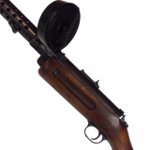
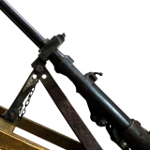
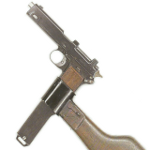
A gun in three parts: the Carabinetta Automatica O.V.P. in collapsed form. The buttstock detaches
from the main receiver body to allow the weapon to be easily stowed in the cockpit of a plane.
(Author's photo via Royal Armouries Collection)
*A note about ammunition
It has been claimed by some experts that the O.V.P. submachine gun can fire, or is intended to fire, 9x19mm Parabellum ammunition. However, the weapon is not actually designed to chamber this round. All weapons of the Villar Perosa family, including the O.V.P. submachine gun and Revelli-Beretta carbine, were originally intended to fire a rare and largely unknown variant of the 9mm Glisenti cartridge, known as Glisenti mod. 1915 per Mitragliatrici ('for Machine-Guns'). This was a higher-velocity version of the standard Glisenti cartridge with an over-powder wad (pictured below), designed to improve the penetration abilities of the weak base cartridge.
Since the Glisenti and Parabellum cartridges are so dimensionally similar, Villar Perosa magazines can be loaded with 9x19mm Parabellum cartridges; however, because the weapons were originally designed for the Italian Glisenti cartridge, firing Parabellum from the O.V.P. submachine gun cannot be recommended, and it is far preferable to load the gun with Glisenti ammunition.
Corrections
The naming practice of the Villar Perosa and its derivatives can be confusing because the Italians used various different names to describe these guns. Previously on this page I wrote that the O.V.P. submachine gun was initially known as the Moschetto Automatico Revelli. This was based on my assumption that the "Revelli" automatic carbine that appears in contemporary trial records referred to the O.V.P., as it was designed by Major Revelli (I believe Thomas Nelson made the same assumption). As it happens, however, the "Revelli" carbine was far more likely referring to the Beretta automatic carbine, which was adopted as the Moschetto Automatico Revelli-Beretta in 1918. Major Revelli gave his personal approval to this design in September 1917 and thereafter his name was attached to it, likely because of the respect that his name carried in the Italian ordnance departments. Therefore any contemporary reference to the Moschetto Automatico Revelli is probably (and slightly confusingly) referring to the Beretta gun.I also wrote on a previous version of this page that the O.V.P. submachine gun was offered for continued commercial export into the late 1920s, evidenced by its testing in Britain and France during that period. In fact, the "Revelli Automatic Rifle" that was demonstrated in these countries was not the O.V.P., but a different weapon that was patented by Revelli in 1927 and was probably made by Metallurgica Bresciana già Tempini (MBT). Major Frank Hobart in his excellent volume The Pictorial History of the Sub-Machine Gun misinterpreted the description of this weapon given in the British trial report to mean the O.V.P. submachine gun. With this in mind, it is probably safe to assume that the O.V.P. submachine gun never re-entered production after 1918.
Gallery


An O.V.P. submachine gun used by Italian communist Ilio Barontini
during the Italo-Ethiopian War. Barontini volunteered to fight
alongside the Ethiopians against fascism. This particular gun was
probably in Ethiopian service when Barontini arrived.
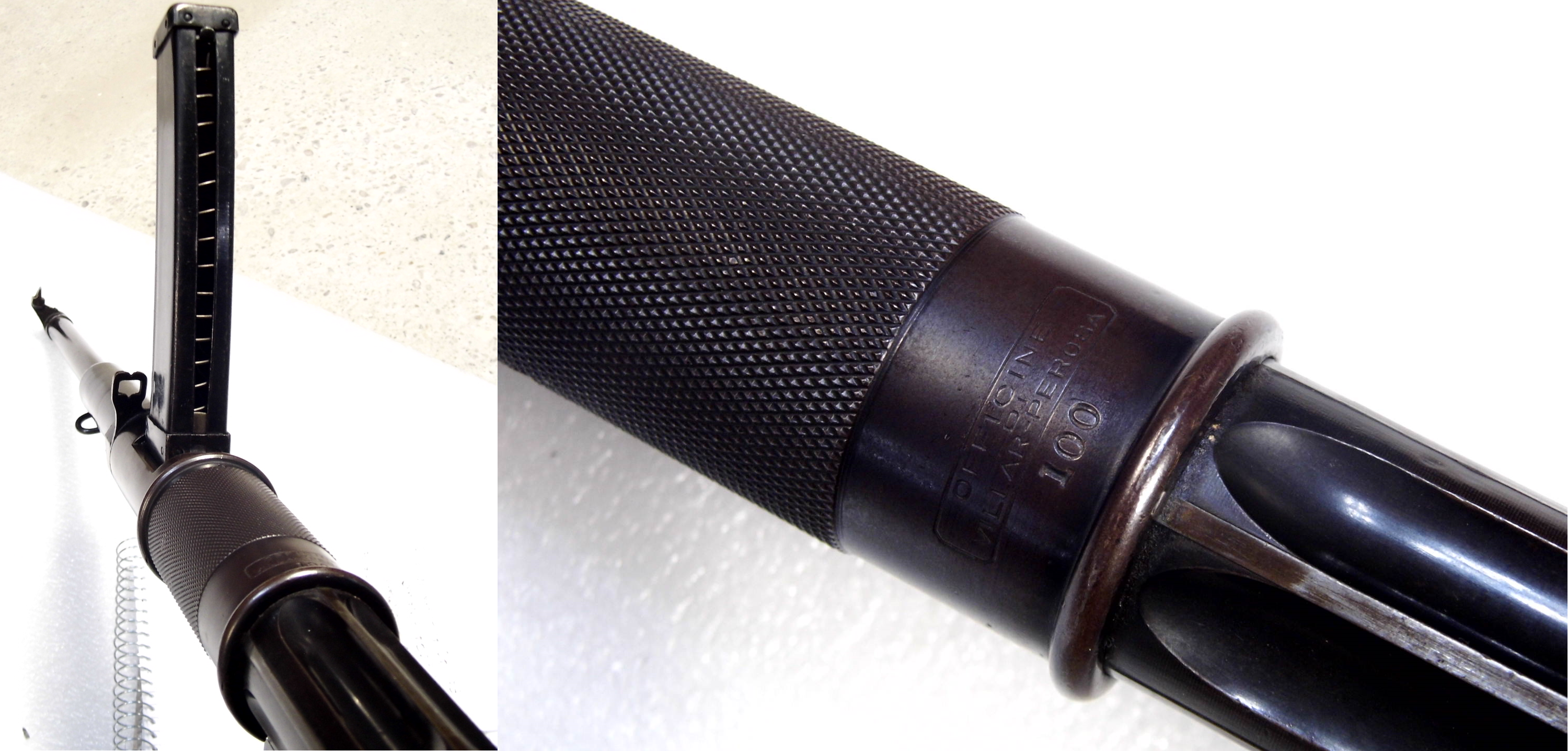
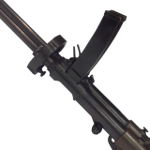
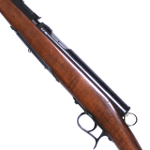
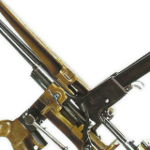
Detail view of the sights (left) and the cocking sleeve (right) of
the Revelli O.V.P. submachine gun,
with the manufacturer's cartouche and serial number #100 marked.
(Author's photo via Royal Armouries Collection)
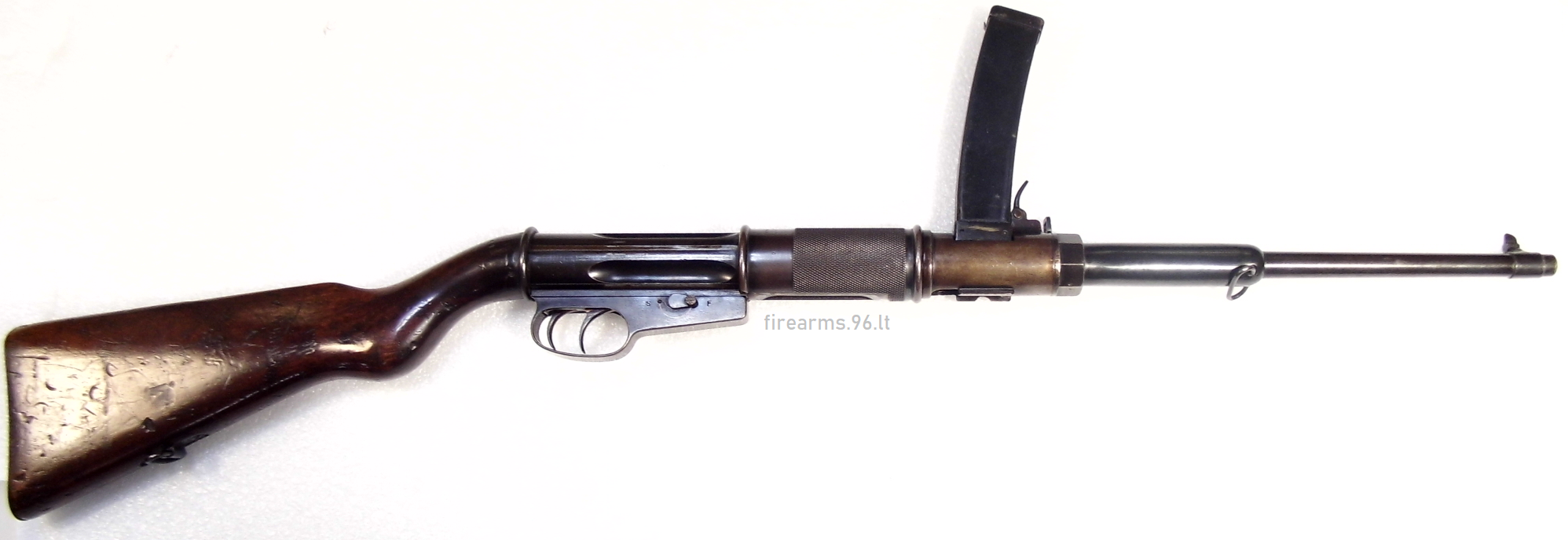
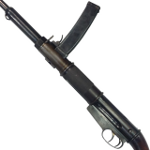
Right side view of the Revelli O.V.P. submachine gun. Note the
safety switch.
(Author's photo via Royal
Armouries Collection)


This article is part of a series on Submachine Guns of the First World War