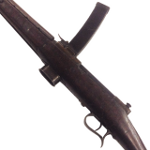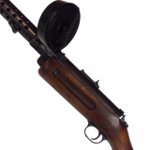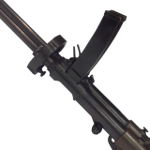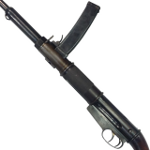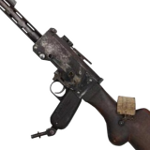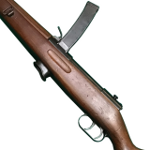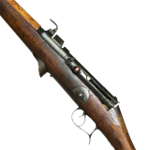
(Photo: Mötz & Schuy)
In 1916
the Österreichische Waffenfabriksgesellschaft (ŒWG) in Steyr became
interested in developing a machine-pistol, predominantly in response to
Italian deployment of the Villar
Perosa submachine gun in their war against Austria-Hungary.
Initially, the 8x18mm Roth Repetierpistole
M.7 was selected for this role, but with a small 8-round
magazine capacity, it did not prove to be successful. By November 1916,
ŒWG proposed a similar conversion of the Selbstladepistole
M.12, the standard Austro-Hungarian service pistol, in addition
to the extension of the magazine to hold 16, 20, or 24 cartridges; this
was received with interest by the K.u.K.
Kriegsministerium. The K.u.K.
KM quickly approved the project, though there was some delay
before work could commence, as ŒWG was subjected to strikes over
worker's rations when
development of the prototypes began.
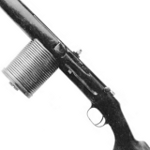
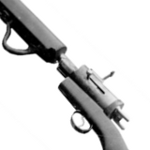
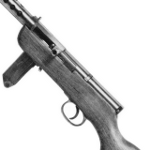
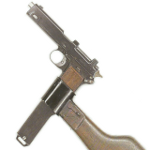
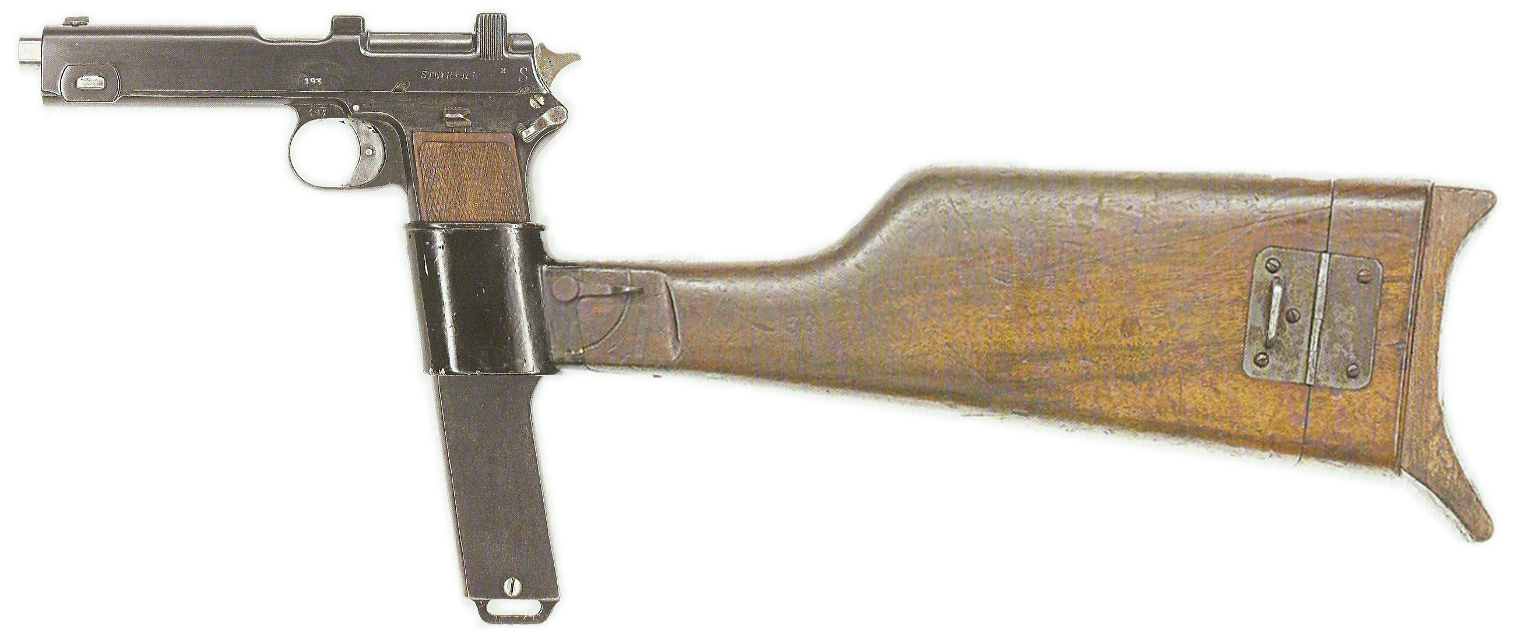
The Anschlagpistole M.12 machine-pistol
was an automatic conversion of the standard Steyr M.12 service pistol,
and the operation was unchanged, incorporating a short recoil action in
which the barrel and slide recoiled together until the barrel was forced
into a 20° rotation by two locking lugs until the slide returned
forward. The only technical difference between the standard M.12 and the
M.12 machine-pistol was the addition of a fire selector switch which
allowed uninterrupted automatic fire, situated on the right side of the
trigger group. The selector mechanism basically consisted of two "arms"
- a long "arm" which was the selector switch itself, and a short "arm"
which acted as a trigger link - both pinned to the trigger group by
connecting screw. The screw passed through the selector switch first,
the trigger link second, and the lastly the trigger itself. The bottom
of the trigger link was itself pinned to the trigger piece. When the
selector switch was flipped up, the screw would turn and drag the
trigger link backward, which in turn would place pressure on the trigger
itself and hold the sear down. Thus, when the trigger was pulled fully,
the pinned-down sear would be prevented from interrupting the action.
This gave an automatic fire rate of about 800 rounds per minute.
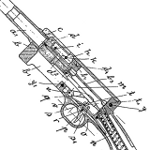
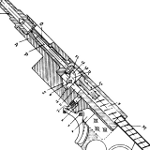
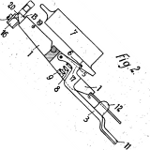
A patent
protecting the fire selector design was filed by ŒWG on December 19th, 1916, entitled Abzugvorrichtung für selbsttätige
Feuerwaffen zur Abgabe von Einzel- und Dauerfeuer ('Trigger
device for automatic firearms for firing single and continuous fire').
However owing to the political situation of the time, it was not
actually published until May 15th 1919, after the war had ended.

ŒWG's
patent of 19th December 1916, protecting the Anschlagpistole
M.12's fire selector.
Early on
it was quickly determined that the 16-round magazine was the most
logistically convenient, as 9x23mm pistol ammunition was
already supplied in boxes of 16 rounds, containing two 8-round clips.
The 24-round magazine would have required three clips to load to full
capacity, and the 20-round magazine would have required two clips plus
four loose cartridges loaded by hand. Therefore the higher-capacity
magazines were quickly discarded. It was also determined that the weapon
could not be fired effectively without a buttstock. A supply of
detachable wooden holster-stocks left over from the production of
standard M.12 pistols was used to provide these machine-pistols with
suitable shoulder support, and were modified with special elongated butt
pads to prevent it from slipping from the user's shoulder during erratic
full-auto fire (not present on the original M.12 stock).
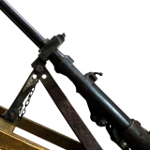
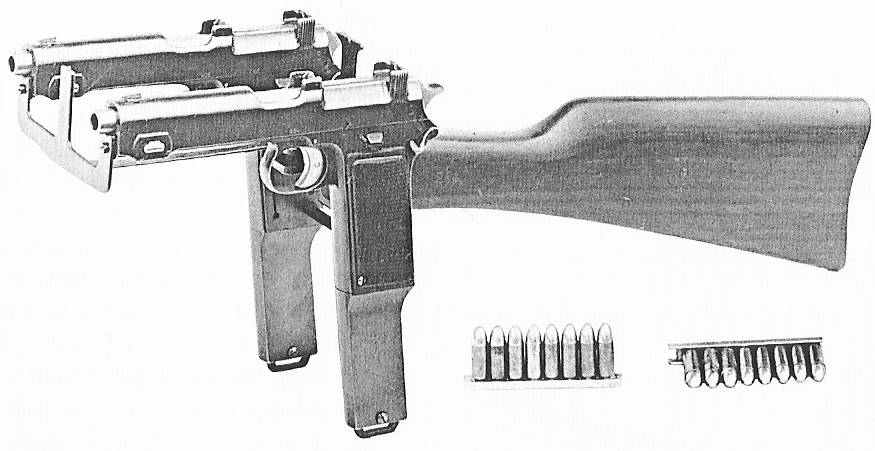
ŒWG
proposed the idea of this machine-pistol with a special configuration,
known as the Doppelpistole M.12,
in mind. This essentially consisted two Anschlagpistolen
tethered together via a central buttstock, with a long
connecting bar linking the two independent triggers (thus allowing both
barrels to fire at once) and a set of rudimentary open notch sights
standing between the guns. This configuration was a clear attempt to imitate
the Villar Perosa, which the Anschlagpistole
was largely developed in response to.
In a series of articles published from 1980 - 1981 for the German magazine Deutsches Waffen-Journal, Lothar Sengewitz gave a completely contradictory account of the history of this weapon, which for a long time was considered the best source and was used by many other authors in their descriptions of the Steyr machine-pistol (in fact, this page formerly used as its main reference). Sengewitz called this weapon the "M.12/P16" (for "Patronen 16" or "16 bullets"), a name that never seems to appear in contemporary records, but has since become widely used by experts as a result of his articles. Among the claims made by Sengewitz include the assertion that it was designed by an officer of the Standschützen, Major Franz Xaver Fuchs, at the end of 1915; that the first unit to receive these weapons was the Standschützen-Bataillon Innsbruck II in February 1916 (though apparently at that time the weapon only had an 8-round magazine capacity); that General von Hotzendorff was personally impressed by the weapon and ordered an immediate batch of 10,000 guns; that they were issued to Sturmtruppen toward the end of the war; that some 9,873 units were recorded in an inventory taken in Tyrol in 1918; that post-war Austrian dictator Engelbert Dollfuss was assassinated by a gunman wielding an M.12/P16; and that the Germans rebarreled some of these weapons to 9x19mm Parabellum and fitted them with silencers for issue to the special Brandenburgers division of the Abwehr.
Practically none of the claims in Sengewitz's article can actually be verified, and at least some are almost certainly entirely false. Most prominently, the suggestion that almost 10,000 guns were actually produced seems to be impossible, particularly taking into account that the highest known serial number among the surviving examples of this gun is 282. There is no evidence at all that mass production of the Steyr machine-pistol was ever undertaken, let alone on Von Hotzendorff's personal order. There is also, to the author's knowledge, no evidence to the claim that Dollfuss was murdered by a soldier wielding a machine-pistol, or that the Germans made a silenced version of it during the Second World War. Mötz & Schuy briefly address Sengewitz's article in their book, writing in a small passage: "In a publication, a Mjr FUCHS of the Standschützen-Battalion Innsbruck II is named as the driving person in connection with the development of the continuous fire M.12 with extended magazine. He is said to have made a significant contribution to this, but we cannot confirm this. He is never mentioned in this context in the relevant files of the KA".