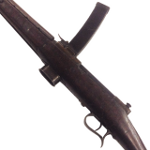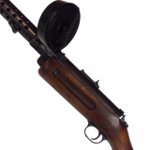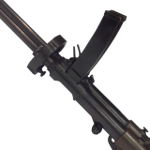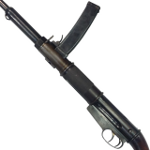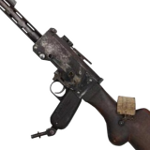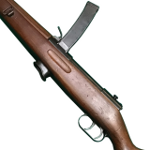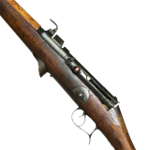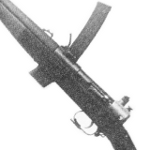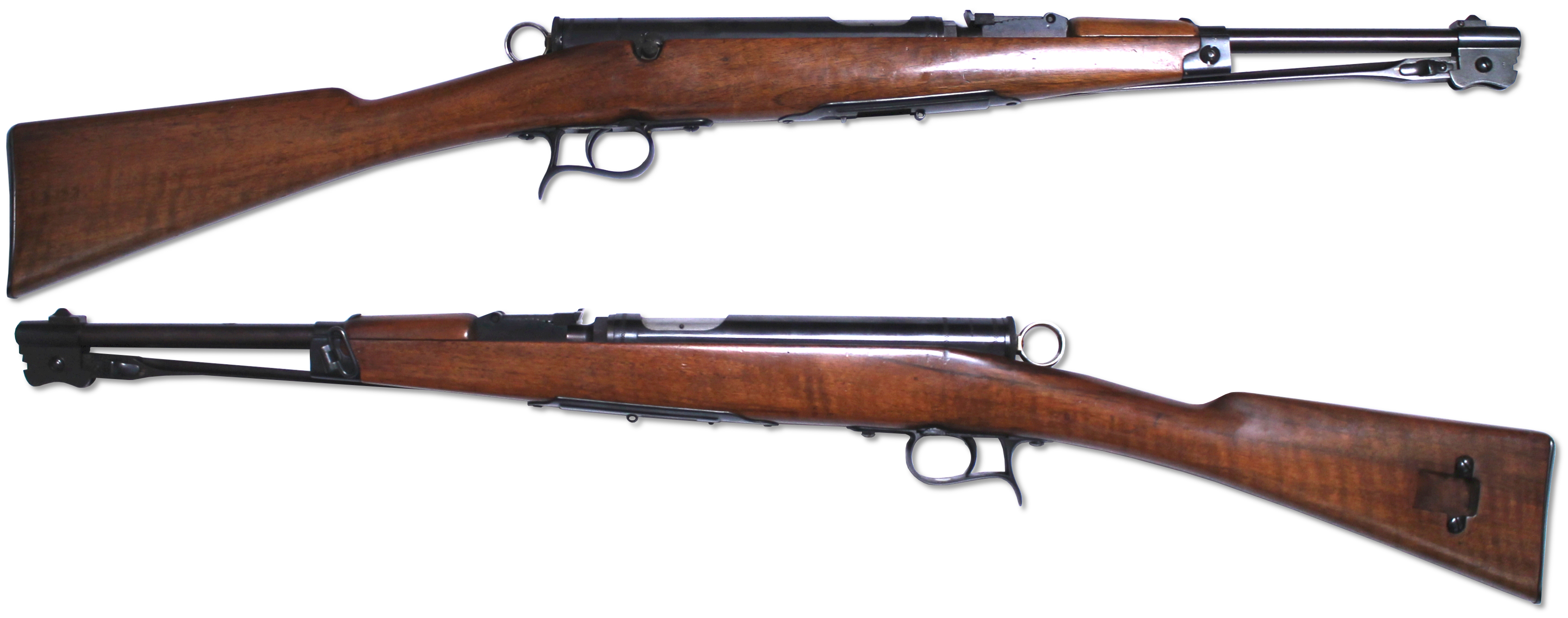
(Photo: Beretta Museum)
There is considerable confusion among even well-read experts over Beretta's Mod. 1918 carbine. The vast majority of sources ubiquitously claim that it was an early submachine gun developed from the Villar Perosa, and was taken into service with the Italian Army in 1918. In fact, the weapon they describe was not the Mod. 1918 at all but rather the Moschetto Automatico Revelli-Beretta (MAR-B), an entirely different weapon which is so often conflated with the Mod. 1918 that the two guns have become inexorably (and inaccurately) identified as variants of one another. Although the Revelli-Beretta did serve as the impetus for the design and construction of the actual Beretta Mod. 1918, these weapons are otherwise completely unrelated.
Since the end of 1916, there had been interest from some quarters of the Italian Army in adopting an automatic carbine in a pistol calibre, initially intended for distribution to aviators as personal defence weapons. The first ideas surrounding this concept were based around converting the twin-barreled Villar Perosa into a single-barreled shoulder arm with a buttstock, including the Carabinetta Automatica OVP, the Moschetto Automatico Savoia, and the aforementioned MAR-B, which was developed by Fabbrica d'Armi Pietro Beretta on commission from Colonel Bethel-Abiel Revelli. Demand for this type of weapon to be issued to infantry assault troops had rapidly grown by early 1918 and after trials comparing many different types, the MAR-B pattern was adopted in September in anticipation for the imminent Vittorio Veneto offensive. Production of the MAR-B at the Beretta and MIDA factories in Brescia began immediately with an order for 10,000 guns.

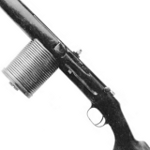
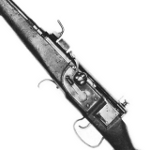
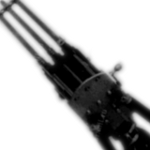
The Moschetto Automatico Revelli-Beretta Mod. 1915 (MAR-B) - NOT the Beretta Mod. 1918 as is ubiquitously
believed. This was a Villar Perosa conversion designed by Colonel Bethel-Abiel Revelli and made by Beretta.
(Author's photo via Royal Armouries
Collection)
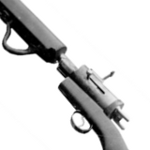
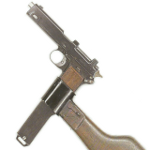
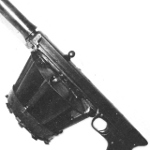
During this same month, Beretta also unveiled a new type of 'moschetto automatico' ('automatic musket'), which was known as the Moschetto Automatico Beretta Mod. 1918 (or MAB Mod. 1918). Design work on the MAB Mod. 1918 carbine was almost certainly undertaken primarily by Tullio Marengoni, without input from Colonel Revelli. The first proof-of-concept prototype made to demonstrate the principles of the MAB Mod. 1918 was actually little more than a MAR-B with an inverted receiver, so that the magazines would feed from the bottom and the spent casings would eject out the top. Without the magazine obstructing the line-of-sight down the bore, the weapon was fitted with a centered pair of sights, including a new type of rear sight system which was adjusted for several graduations via a sliding tab that ran underneath it (this was very similar in style to the rear sight of the later Reising Model 50 submachine gun produced in the United States). There was also a retractable cover built onto the feed opening to prevent the entry of dirt when no magazine was loaded. Mechanically, however, this early prototype was still operating on the Villar Perosa's open-bolt action and was not yet a new design in its own right.
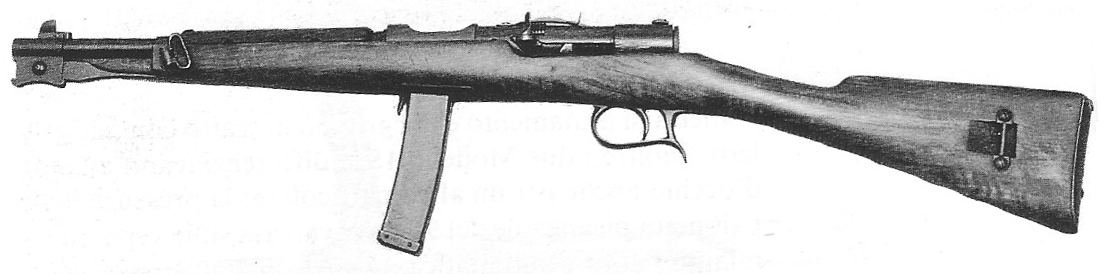
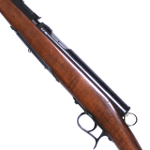
The early proof-of-concept prototype for what would become the MAB Mod. 1918 - actually just
a MAR-B with is receiver inverted. This was probably used to demonstrate the principles of
Marengoni's new design before the actual prototypes were built.
(Photo: Beretta Museum)
In later prototypes, Marengoni did away with all aspects of the Villar Perosa and implemented his intended system for the MAB Mod. 1918 - a new firing action which operated from a closed bolt with an independent charging handle that did not reciprocate with the bolt upon firing. The charging handle was shaped like a ring and was connected to the bolt via a long rod which carried the recoil spring (therefore also doubling as a buffer). It protruded from the end cap of the receiver and when it was retracted, it pulled the bolt back with it. The bolt's rearward travel with the charging handle would set the hammer down into the cocked position, and when the charging handle was released, the bolt would return to the forward (closed) position again. Pulling the trigger would not trip the bolt as per an open bolt gun, but rather the hammer, which pushed the firing pin forward and fired the chambered cartridge. On firing, the bolt would complete a full cycle as the spent round was ejected and the new round was chambered, and the hammer and firing pin would be reset for the next trigger pull.
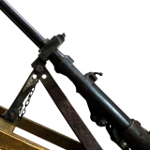
The MAB Mod. 1918 also introduced a new type of magazine feed which did not take the standard 25-round Villar Perosa magazines as used by the MAR-B, but instead a proprietary magazine was produced in capacities of 12 and 25 rounds. This was a double-stacked magazine with a single position feed and was somewhat similar in construction to the later Schmeisser pattern magazine that was used in the German MP 28,II submachine gun. The magazines loaded from the underside of the receiver and were straight instead of curved. Externally, the furniture used in the MAB Mod. 1918 was largely the same as the MAR-B, and in most examples it even retained the folding cavalry-type spike bayonet which was present in that weapon - though a few MAB Mod. 1918s were made with full-length stocks resembling that of the Carcano 'Truppe Speciali' carbine, designed to mount a detachable Mod. 1891 sword bayonet. It is also notable that whilst some MAB Mod. 1918s were made with the aforementioned proprietary rear sight, others were simply fitted with basic rifle-style tangent sights.
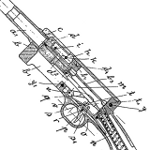
A patent protecting Marengoni's design was acquired by Pietro Beretta on the 28th of September 1918, entitled 'Moschetto automatico mod. 1918 per la cartucce regolmentari mod. 1910' ('Automatic musket model 1918 for the regulatory cartridge model 1910', the cartridge referring to 9x19mm Glisenti). This patent came just 26 days after the patent protecting the MAR-B had been secured. In correspondence to the Department of Arms & Artillery earlier that month, Pietro Beretta had affirmed his company's commitment to "the transformation of OVP [Villar Perosa] machine guns into automatic muskets, and the new "BERETTA" automatic musket under construction". Here, Beretta clearly speaks of two different types of 'moschetto automatico' - the Villar Perosa convesion, which is the MAR-B, and a separate Beretta type in development, which is the MAB Mod. 1918.
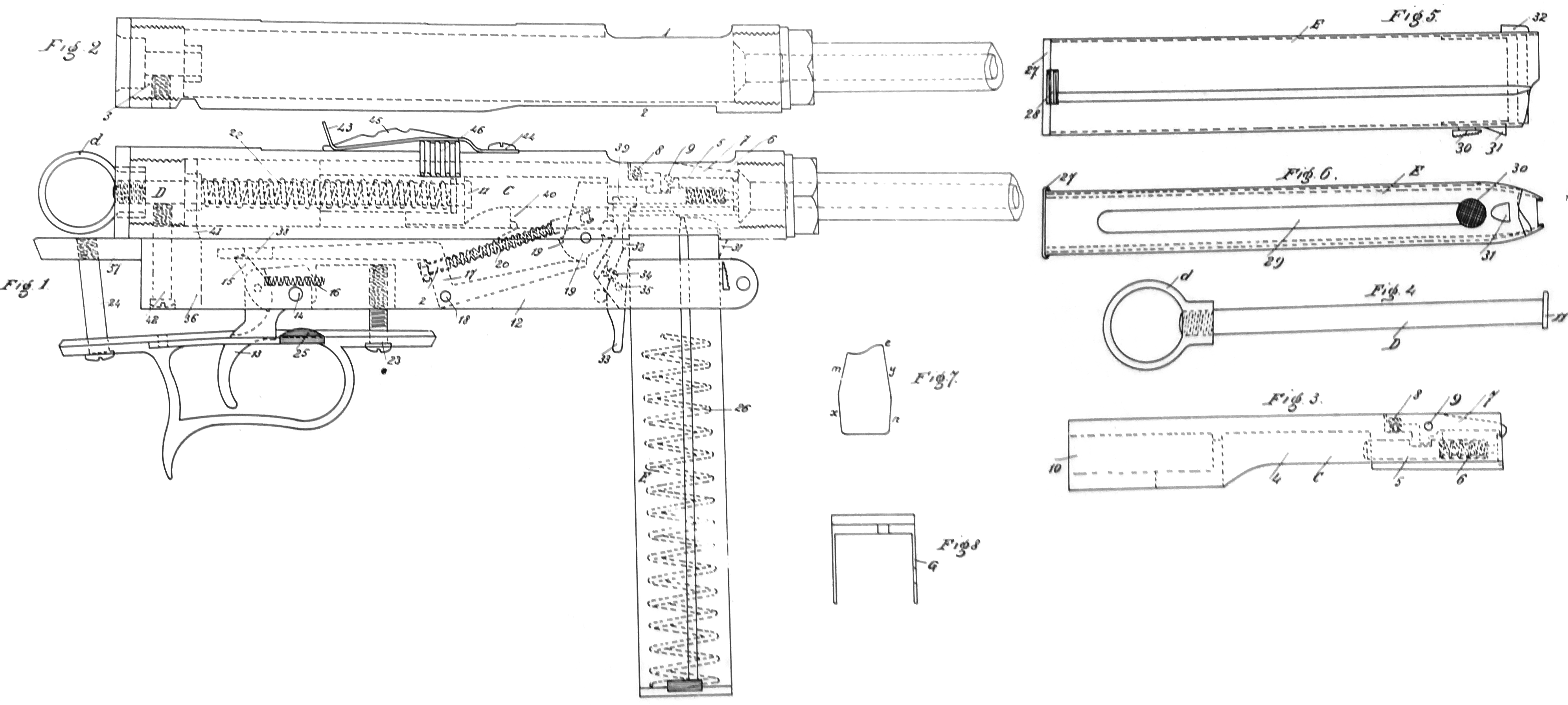
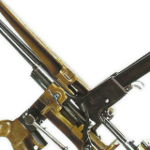
Pietro Beretta's patent of 28th September 1918, protecting the MAB Mod. 1918's design, including
the new type of magazine and charging handle. It shares nothing in common with the MAR-B
except for the Vetterli-type trigger guard and buttstock.
The MAB Mod. 1918 was superior in most aspects to the MAR-B. The closed bolt action was more comfortable to shoot, gave better accuracy on each trigger pull, and did not have the disadvantage of bearing an open breech whilst cocked. All parts, except the Vetterli trigger guards and the Carcano spike bayonets, were made at the Beretta factory to a high standard, in contrast to the MAR-B's heavy reliance on recycling mass-produced components from existing Villar Perosas. The result was a much better carbine which could fill the same role as the MAR-B. However in late 1918, with victory in the war imminent and the MAR-B already having been adopted with an order for 10,000 guns, there was no pressing demand for another type of automatic carbine in Italian service and no sales for the MAB Mod. 1918 were secured at this time.
After the war, Beretta terminated manufacture of the MAR-B but retained the MAB Mod. 1918 on their product list, appearing in their sales catalogues throughout the 1920s. It is not clear how many were made during this time and who was purchasing them; passing reference was made in contemporary reports to the use of the "moschetto automatico Beretta" by the Carabinieri in quelling a major riot in Viareggio in May 1920, but it is not clear whether this was referring to the MAR-B or the MAB Mod. 1918. Demonstrations of the gun were also made to the Alpini in December 1925, undertaken by Pietro Beretta personally, who clearly had greater faith in his proprietary carbine than he did in the MAR-B. In any case, sales were certainly slow initially, and there were no known export orders.
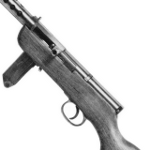
In 1928, Beretta constructed a special gold-plated MAB Mod. 1918 carbine with Amharic inscriptions, made as a gift to the Ethiopian King, Ras Tafari (Haile Selassie). This was likely intended to be presented to Tafari by Mussolini as part of the Italo-Ethiopian Treaty of Friendship that was signed that year. However for whatever reason, this carbine still resides in the Beretta Museum to this day, indicating that it may never have actually left the factory. According to one source, this is because there were actually several of these ceremonial guns made for Tafari's palace guard. Tafari's carbine is interesting because it included several non-standard features for the MAB Mod. 1918. Most notably the trigger group was entirely reworked with a new mechanism in which the trigger actuated a tilting block (quite similar to that seen in the MAR-B) which in turn tripped the sear. The new trigger was built at a back-set angle and there was less distance and pressure on pull. The bolt release switch was also relocated to the forward receiver so that the bolt could be locked in the closed position.
From 1930 onward, the improvements featured in Tafari's MAB Mod. 1918 were standardized and the weapon was manufactured under a new name, Mod. 1918/30, with the suffix representing the date of a patent that had been acquired to protect the improved trigger mechanism. This was also reflected in the markings on the receiver which read 'BREVETTO 1918 - 1930'. With this updated model, the aging carbine received a new lease of life which proved greatly more successful than the base model had been. Substantial orders were made by domestic law enforcement agencies such as the Carabinieri, the Milizia Forestale, and most prominently, the paramilitary wing of the Fascist Party, known as the Milizia Volontaria per la Sicurezza Nazionale (MVSN). It was typically issued with a bandolier containing four pouches, comprising two 12-round magazines and two 25-round magazines. The Italian Army did not made significant orders of this weapon, only purchasing a few hundred guns. In early 1936, amidst the Italian invasion of Ethiopia, a small batch of 50 MAB Mod. 1918/30 carbines were distributed to colonial tank crews in East Africa, along with 325,000 rounds of 9x19mm Glisenti ammunition. Some guns were also recorded as having been used by MVSN volunteers fighting in the Spanish Civil War (1936 - 1939).

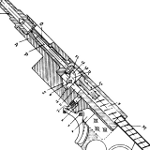
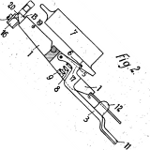
Cross-sectional diagram of the MAB Mod. 1918/30, incorporating improvements to the trigger mechanism
and bolt release that had been made in the late 1920s. This supplanted the MAB Mod. 1918 in production.
Beretta also attempted to secure international export sales for the MAB Mod. 1918/30. Trial samples were sent to Britain, the United States, Finland, Saudi Arabia, and the Vatican City. In Britain, the representatives of the weapon were the Soley Armaments Company, who had acquired samples but refused to sell them - indicating that they were not an officially licensed sales outlet. Most of the trials in other countries also not not result in any significant sales. The largest foreign order was made by Argentina, where the MAB Mod. 1918/30 was adopted as the 'Carabina Automatica Beretta' by the Buenos Aires Provincial Police. These guns were stamped 'POLICIA DE LA PROVINCIA DE BUENOS AIRES'. The Argentinian Police even designed a special firing port on the windshields of their cars through which the barrel of the MAB Mod. 1918/30 would be fired from. The MAB Mod. 1918/30 remained in service in Argentina for many decades, though by the 1970s - 80s it was largely relegated to a ceremonial role. It is still used as a ceremonial weapon by the Carabinieri in Italy today.
Illicit sales of the MAB Mod. 1918/30 were also made to the French terrorist organization La Cagoule, in deals brokered through Galeazzo Ciano. These weapons were trafficked through Switzerland in exchange for favours to Mussolini's regime, including the assassination of dissident . There is some evidence that the MAB Mod. 1918/30s received by La Cagoule may have been 'sanitized', i.e. cleaned of manufacturer's stamps, likely to conceal their origin. A large portion of these guns were discovered and confiscated by the French police during a raid on one of La Cagoule's arms caches in Paris.
The MAB Mod. 1918/30 saw combat use in several conflicts of the period. Other than the Italian military adventures in Spain and Ethiopia, the weapon was still in service by the time of the Second World War and were used predominantly in the North African campaign by the Colonial Corps. After 1943, the MAB Mod. 1918/30 occasionally cropped up in the hands of combatants fighting for both the CLN and the RSI, but the Beretta factory was by then almost wholly preoccupied with the production of the MAB Mod. 38/A submachine gun on behalf of German and Italian Fascist troops. Nevertheless, limited production of MAB Mod. 1918/30 carbines is said to have continued even after the war, predominantly on behalf of existing customers such as Argentina. Today, many of these ex-Argentinian surplus guns can be found in private ownership in the United States.
Resources used:
- Pietro Beretta,
Moschetto automatico mod. 1918 per la cartucce regolamentari mod.
1910 (28th September, 1918).
- Vittorio Balzi, I Mitra Italiani 1915 - 1991 (Florence: Editoriale Olimpia, 1992).
- Nicola Pignato & Filippo
Cappellano, Le Armi della Fanteria
Italiana (1919 - 1945) (Parma: Storia Militare, 2008).
- Additional information provided
by Valentino Pescetelli of the Beretta Museum.
This article is part of a series on Submachine Guns of the First World War