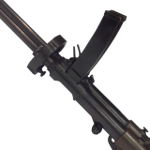
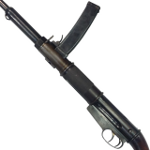
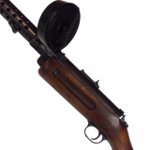
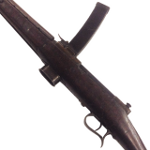
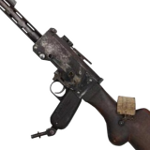
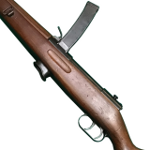
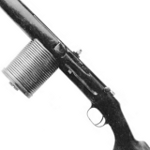
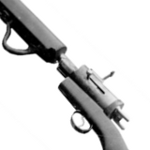
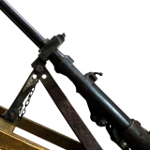
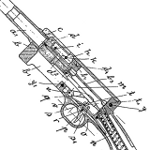
Fiat mod. 1915 machine pistol (Villar Perosa)
[IT]
Pistola Mitragliatrice Fiat mod. 1915

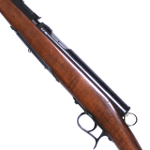
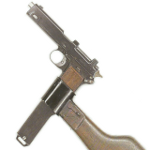
(Author's photo via Royal Armouries Collection)
The Villar Perosa was the first submachine gun or machine pistol to be used by any military, adopted by the Italian Army in 1915 and used by them on a large scale throughout the First World War. The weapon was conceived and initially manufactured at the Officine di Villar Perosa, a small factory located in, and named for, the small town of Villar Perosa on the outskirts of Turin. The O.V.P. factory was controlled by Roberto Incerti & C. - Villar Perosa S.A. (R.I.V.), which was itself a subsidiary of the larger FIAT automobile company in Turin. Villar Perosa was in fact the birthplace of Fiat's founder Giovanni Agnelli; the location of the factory was deliberately chosen by Agnelli to create employment for his local community.
The
Officine di Villar Perosa was not primarily an armaments business and,
prior to the First World War, had chiefly engaged in the manufacture
of ball bearings. Its sudden transition to developing small arms came
quite suddenly and without clear precedent in about 1911 when it was
named as the assignee of a patent protecting a self-loading rifle
operated by recoil. In fact, this rifle had originally been designed
by the engineer Fillipo Genovesi, entirely unconnected to the O.V.P.,
and subsequently improved by Capitano Bethel-Abiel Revelli di Beaumont
on behalf of the Italian Army. Exactly how the O.V.P. factory became
involved in the late development of this rifle is unclear, however it
is known that by this time Capitano Revelli had become associated with
Fiat through the development of the Fiat-Revelli machine gun, later
adopted as the standard medium machine gun of the Italian Army in
1914. During Revelli's tenure working with Fiat's armaments division,
it seems that for whatever reason, some of his projects were delegated
to the O.V.P. works.
Despite
a considerable sum of money being devoted to the project, Capitano
Revelli's self-loading rifle, known as the Fucile
automatico, was not successful and after being rejected for
service with the infantry, only a small number of guns were taken into
service as armaments for military aviators
in November 1914. Therefore the O.V.P.'s first foray into the
production of military small arms did not result in a major contract.
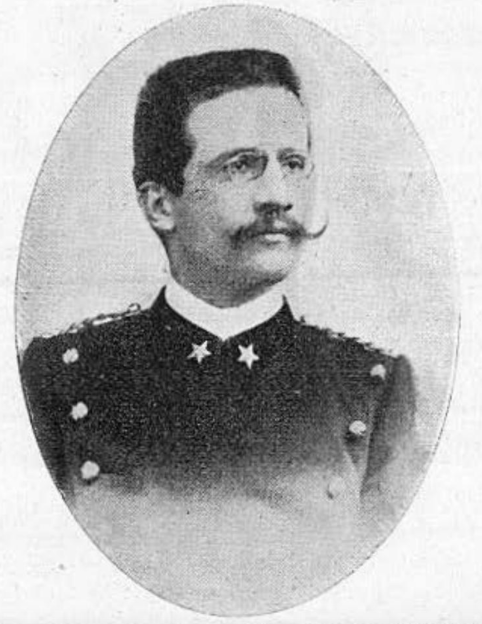
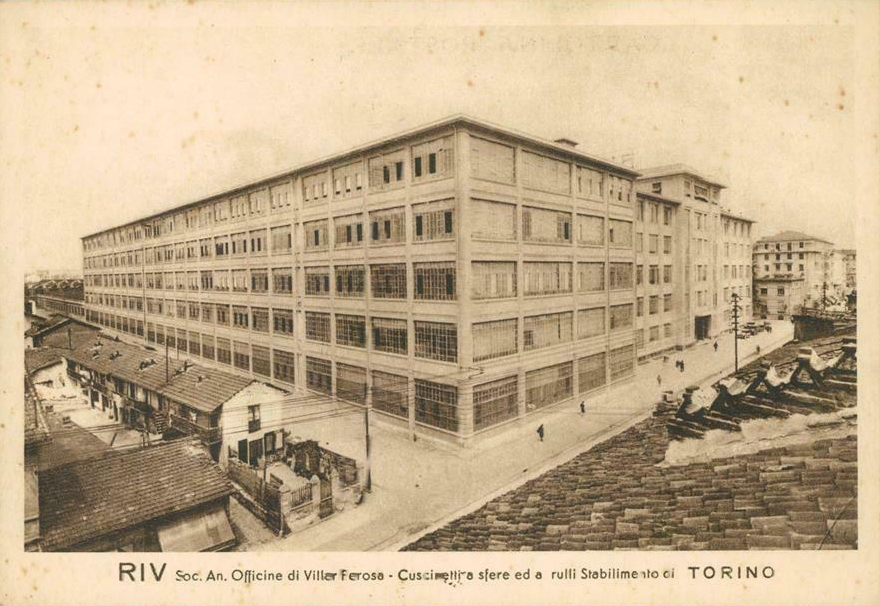
Capitano (later Colonnello)
Bethel-Abiel Revelli di Beaumont (left) and R.I.V.'s Officine di
Villar Perosa plant near Pinerolo (right).
By
early 1915, the Officine di Villar Perosa had become the actual
manufacturer of a new automatic gun, also credited to Bethel-Abiel
Revelli. This weapon was unlike any other which existed at the time,
taking the form of a twin-barreled, magazine-fed machine gun of an
extremely compact size and light weight, and chambered for a 9 mm
pistol cartridge. No precise terminology existed in contemporary
military parlance to describe a weapon of this type; it was promoted
by the company as a 'Petit
mitraillette' ('Small machine gun') in early French-language
marketing for export sales, while their domestic manuals named it as
the 'Pistola
mitragliatrice O.V.P.' ('Machine pistol'). The term 'machine
pistol' became the preferred naming convention within Italy to
describe this weapon.
Though it is often claimed that the Villar Perosa was originally designed as an aerial arm, it is in fact not clear what the original impetus for the development of this weapon was. Certainly the newly-established Corpo Aeronautico Militare ('Military Aviation Corps') were the first to purchase the weapon, ordering a trial batch of 50 guns in April 1915 for experimental use on Farman MF. 11 reconnaissance planes (see: The Villar Perosa in aerial service). However later in 1917 the chief of the Reparto Aereo di Artiglieria (Department of Aerial Artillery), Colonello Aurelio Bontempelli, stated quite emphatically that the Villar Perosa had not originally been conceived as an aerial armament:
"The Aviation Corps were the first to adopt the Fiat machine gun and machine pistol, weapons which, although originally designed for the infantry, had not had the initial favour they rightly enjoy now."
A
manual printed by Offine di Villar Perosa in 1916 contains two
photographs of a cavalryman demonstrating the weapon, very probably
taken at the Scuola di Applicazione di Cavalleria in Pinerolo, just 10
km (6 miles) from Villar Perosa. The extremely close proximity of the
O.V.P. factory to this cavalry school, combined with the lightweight
and compact attributes of the weapon itself, creates another
possibility for whom the Villar Perosa may have been intended for.
Despite this, the cavalry did not adopt the Villar Perosa.


A soldier of an unidentified Reggimenti di Cavalleria demonstrating an early iteration of the Villar Perosa in terrestrial configuration, with shield mount and carrying case, likely
at the Scuola di Applicazione di Cavalleria in Pinerolo, c. 1915.
Italy's
entry into the war on the 23rd of May 1915, on the side of the Triple
Entente and against Austria-Hungary, created an urgent demand for
machine guns. The mitragliatrice Fiat-Revelli mod. 1914 medium machine
gun, also designed by Revelli, was already in service in limited
numbers and was relied upon to fulfill the army's domestic supply of
machine guns. Foreign exports, such as the mitragliatrici mod. 1907
(St Étienne), mod. 1911 (Vickers), and mod. 1914 (Colt) were purchased
with haste but these could not be relied upon to become standardised
across the whole army as Britain and France understandably reserved
the majority of their produce for their own war efforts. The army
therefore looked to adopting more domestically-produced arms and
investigated the potential of issuing the O.V.P. machine pistol
alongside medium machine guns in order to increase the firepower of
infantry further. The necessary arrangements to make this possible
were rapidly made through the middle months of 1915, and in August the
machine pistol was officially taken into service under the designation
Pistola
mitragliatrice Fiat mod. 1915; though today it is commonly
known as simply the 'Villar Perosa', and will be referred to as such
herein for simplicity's sake.
The
Officine di Villar Perosa acquired a patent protecting the design of
this new weapon on the 8th of September 1915, entitled Arma
da fuoco automatica extra rapida ('Extra fast-firing
automatic firearm'). An additional patent was secured 16 days later,
on the 24th September, protecting a proprietary gun shield for the
Villar Perosa and the associated disc-shaped connecting joint to allow
the weapon to be fitted to the shield, officially referred to as a
'ball and socket' joint by the O.V.P.. Successful international patent
applications were also made in Britain, France, Germany, and later the
United States.
Design
elements of the Villar Perosa
In
design the Villar Perosa comprised two separate guns, each with
independent firing mechanisms, which were physically joined into one
weapon. The firing mechanisms were contained within a pair of tubular
receivers which were joined at the rear by a pair of brass spade grips
which formed the end caps of the receivers and carried the triggers.
Each receiver fed from a detachable box magazine, loaded into feed
openings located on top of the receivers, and spent cartridges were
ejected from ejection openings placed directly underneath the magazine
feeds. Spherical cocking handles protruded from slots cut into the
right side of both receivers.
Running
between the underside of both receivers was a lateral connecting
crossbar, which appears to have originally been employed as a mounting
point for the weapon (see below), though was soon adapted to carry a
pair of retracting pawls which were used to assist in the retraction
of the cocking handles; this feature was probably implemented in
response to feedback that the left cocking handle, being located
between the receivers, was difficult for the operator to directly
reach by hand.


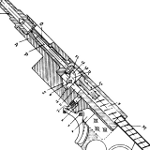
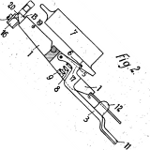
Patent drawing of the Villar Perosa, dated 8th September 1915. This diagram is drawn from the photograph of the early pre-production model Villar Perosa, shown above, and therefore several features of the
finished model are absent. The rhomboid-shaped locking mechanism built into the cocking handle slot of the receiver is shown right.
The operation of the Villar Perosa relied on a delayed blowback principle, in which the bolt was moved by the force of the gases generated by the ignition of the chambered cartridge upon firing, but interrupted by a mechanical delay acting against the bolt's rearward travel. The retarding mechanism which created this delay was an inertial catch which forced a small rotation of the bolt. A rhomboid-shaped slot (referred to as a 'shoe' by the Officine di Villar Perosa) was cut into the front section of the cocking slot on the right side of each receiver, which formed the end of the bolt path. A rhomboid of corresponding shape and size, which acted as the base of the bolt handle, protruded from the right side of the bolt body and, on the bolt's forward travel toward the breech, this rhomboid engaged the 'shoe' in the cocking slot, causing the entire bolt body to rotate about 15°. The rotation of the bolt body caused the firing pin to come forward and strike the cartridge in the chamber. Therefore the chambered cartridge would only be ignited once the bolt face had fully closed against the chamber, minimising the chance of 'out-of-battery' discharges in which a cartridge was accidentally ignited before the weapon was ready to fire.
The
trigger mechanisms of the Villar Perosa were extremely simple; both
triggers took the form of a long L-shaped levers affixed to a set of
hinges on the underside of the twin end caps, and actuated by a pair
of springs fitted to the rear faces of the end caps. The top ends of
the trigger levers carried notched buttons for the user to press in
with their thumbs, while the bottom ends of the levers carried the
sears, which penetrated through the bottom of the receivers to engage
directly with the bolts. Pressing in the trigger buttons tilted the
levers forward, therefore bringing the sears out of engagement with
the cocked bolts and allowing them to travel forward to the breech.
The feed system employed in the Villar Perosa was a box magazine of 25 rounds. The magazine used a double-stacked arrangement, in which the cartridges were contained in staggered rows. Additionally the magazine opening employed a 'double-position' feed in which the cartridges could feed into the receiver from either the left or right side of the magazine lips. The magazine was also designed with an open cut-out window which would allow the operator to observe the number of rounds remaining within the magazine. A disadvantage of this, however, was that it also allowed the entry of dirt into the magazine, potentially causing fouling issues.


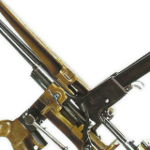
Left: Villar Perosa with internal components; triggers, recoil springs, bolts and firing pins, and mounting bracket. Right: The early type Villar Perosa magazine feed (top),
with rotating locking collars and fixed spurs; and the later type magazine feed (bottom), with spring-loaded magazine release catches and prominent protector wings on
either side of the feed openings.
(Österreichische Nationalbibliothek)
(Vittorio Balzi)
In the
first iteration of the Villar Perosa, the attachment of the magazines
to the receivers was achieved through an unorthodox feed mechanism in
which the feed openings were encased by locking collars. In order to
load the magazines into the receivers, these collars were rotated
anti-clockwise to unlock the feed openings and allow a magazine to be inserted, then returned clockwise in
order to lock the magazines into place. In initial prototype models,
the locking collars were only built with small tabs for the operator
to grip in order to force their rotation. As this proved inadequate
during early testing, enlarged spurs were added to these tabs in order
to create a more tactile point of grip with which to rotate the
locking collars. Eventually the rotating feed collars would be phased
out and replaced by a static feed housing with simpler spring-loaded
magazine release catches placed in front of the magazines (see: Development of Villar Perosa assault
tactics). This development was protected under a patent dated
26th January 1917 by engineer Giovanni Cristiani.
The
Villar Perosa was built in two configurations: an infantry type and an
aerial type. There was no difference in mechanical design or operation
between these two configurations; rather they only varied in methods
of sighting and mounting the weapon. In the infantry type
configuration, a large disc-shaped bracket was fitted to the threading
at the rear of the barrel. This disc unit doubled as both a sighting
system and an attachment point for a terrestrial shield mount. The
front sight was screwed to the centre face of the disc bracket and
carried five sequential sight posts of different lengths,
corresponding to ranges of 100 metres - 500 metres. The front sight
unit could be manually rotated on its screw to bring each sequential
sight post into alignment with a large aperture window bored through
the upper face of the disc bracket, depending on which range the user
wished to fire from. In this configuration, the rear sight was a small
aperture perforating through the fire selector switch, between the
twin trigger buttons, which aligned with the front sight post and
aperture of the disc bracket.
The gun shield for which the infantry type configuration was designed to be attached to was a flat, square sheet of thick steel, standing on two folding legs, with a porthole bored through the centre into which the disc bracket of the infantry type gun was mounted. The convex and concave cuts along the sides of the disc bracket and porthole respectively allowed limited horizontal and vertical movement of the gun. With the gun mounted to the shield, only the aperture of the disc bracket provided an opening through which the gunner could sight their target; this provided complete concealment to the gunner firing from a prone position or from a parapet, and in theory gave them thorough protection from incoming small arms fire. This gun shield was the subject of a patent filed by the Officine di Villar Perosa on the 24th September 1915.
The
aerial configuration of the Villar Perosa did not include the
aforementioned disc bracket. Mounting of the weapon in aerial
configuration was achieved by one of two means; initially the
connecting crossbar running beneath the receivers served as the
mounting point, onto which a gimbal was attached. Later, this was
abandoned in favour of a flexible pintle mount secured to the rear
sections of the barrels and secured by two large nuts, attached by the
same means as the circular bracket of the infantry configuration. This
provided superior maneuverability of the weapon from a stationary
point and better support in firing.
In
some versions of the aerial configuration, the size of the spurs on
the locking collars were increased, presumably to facilitate for thick
gloves worn by aviators; though this was not ubiquitous. As per the
infantry configuration, the rotating locking collars were later
replaced by simpler spring-loaded magazine catches with feed
protecting wings on either side of the magazine openings.


The
aerial configuration of the Villar Perosa employed a set of elevated
sights which contained three stages of graduation, for 100, 300, and
500 metre ranges. The rear sight was not contained within the fire
selector switch but instead mounted on top of it, and was a large
hollow aperture containing three open notch sights corresponding to
the aforementioned ranges. The front sight was similar but contained a
single fixed post within its aperture.
In some later versions of the aerial configuration Villar Perosa, the
three-stage aperture rear sight was replaced with a singular open
notch sight, and the front sight aperture was eliminated entirely and
replaced by a basic post. This these simplified sights were perhaps
introduced owing to the impracticality of attempting to accurately
fire the Villar Perosa at ranges of over 100 metres. This model,
however, appears to have been rare.
The Villar Perosa in infantry configuration weighed about 8.15 kg (17.9 lb) unloaded. The total length of the weapon was 605 mm (23.8 in), and the barrels were of 315 mm (12.4 in) length. The cyclic fire rate of the Villar Perosa was about 1,200 rounds per minute from one barrel, or 2,400 rounds with both barrels firing simultaneously. The results of firing tests published by the Officine di Villar Perosa claimed that the weapon created a cone of fire of 1 m² at an 100 metre range; 4 m² at a 300 metre range; and 8 m² at a 500 metre range. In contemporary Italian military doctrine, the maximum effective range of the Villar Perosa was considered to be 300 metres.
Ammunition
of the Villar Perosa
While initially chambered for the standard 9×19 mm Glisenti cartridge as used in the Italian service Pistola automatica mod. 1910, a special variant of the Glisenti cartridge was developed specifically for use in the Villar Perosa upon its adoption, known as the 'Cartucce regolamentari mod. 1915 per mitragliatrici' ('Regulatory cartridge mod. 1915 for machine guns'). This was modified with a circular wad of felt inserted inside the cartridge casing which compressed the load, thus generating marginally higher bullet velocity and accuracy on firing. The mod. 1915 cartridge was standardised for the Villar Perosa in both infantry and aerial use.
Due to the identical cartridge
dimensions, the Villar Perosa could also operate using the German
9×19 mm Parabellum cartridge; this was performed successfully during
British trials of the gun in 1915 (see: Foreign
trials of the Villar Perosa), but was not standard practice
and never officially endorsed in Italian service.
The Villar Perosa in infantry
service


Left: Generale Luigi Cadorna, Supreme Commander of the Italian Army, examining the Villar Perosa during demonstrations in August 1915. Right: Typical example of the early pattern
Villar Perosa machine pistol, complete with the original shield mount. This was the standard version of the weapon adopted by the Italian Army for issue to infantry troops in 1916.
(Museo Storico Italiano della Guerra/Herman Historica)
Following the adoption of the Villar Perosa in late 1915, the Italian Army formulated the infantry component which would be equipped with this weapon, known as the Sezione Pistola Mitragliatrice ('Machine Pistol Section'). This was a platoon-sized section comprising 28 men issued with two machine pistols. In effect this was itself divided into two squads of 14 men with one gun team attached to each. The core gun crews were made up of seven men: a gunner, an assistant loader, the shield-bearer, and four ammunition carriers. The other twelve men of the section were auxiliary members of the squads; regular infantrymen who carried additional ammunition for the gun and could be called upon to replace potential losses in the main gun crews. Troops who were trained in the use of the Villar Perosa were given a special badge to denote proficiency with these weapons (shown below). Each gun was issued with a wooden chest containing ten spare magazines, a cleaning kit, and two replacement barrels.
Initially,
the army intended to assign two machine pistol sections per battalion;
however owing to logistical obstacles, this was not possible and the
number of sections per battalion was amended to only one throughout
the first year of the weapon's service.
Composition of the Sezione Pistola Mitragliatrice (April 1916)
| Personnel |
Rank |
Armament |
| 1 section commander |
Tenete |
Pistola
a Rotazione mod. 1889/ Pistola automatica mod. 1910 |
| 2 gun commanders |
Sergente/Caporali
Maggiore |
Fucile
mod. 1891 |
| 2 gunners |
Soldati |
Pistola
mitragliatrice mod. 1915 |
| 2 shield carriers |
Soldati |
Fucile
mod. 1891 |
| 1 ammunition commander |
Sergente/Caporale
Maggiore |
Fucile
mod. 1891 |
| 8 magazine carriers |
Soldati |
Fucile
mod. 1891 |
| 12 ammunition carriers |
Soldati |
Fucile
mod. 1891 |
An initial order for 2,480 guns for
distribution to infantry troops was granted jointly to the Officine di
Villar Perosa and the
Metallurgica Bresciana già Tempini (MBT) in December 1915,
with a completion target of June 1916. Manufacture of the shield
mounts was subcontracted to Gio Ansaldo & C. of Genoa and the
Arsenale di Costruzione d'Artiglieria of Turin, and the Fabbrica d'Armi Pietro
Beretta in Brescia was selected as a subcontractor for barrels and
extractors. The first
batch of machine pistols to be delivered to the infantry arrived in
April 1916, and consisted 125 guns (divided between the 1ª and 3ª Armati), and further
orders were immediately placed in the following months. The Villar
Perosa was first fielded in combat during the Battle of Asiago (15th
May - 10th June), during which an additional 239 guns were delivered
to the 1ª
and 5ª
Armati who faced the bulk of the Austro-Hungarian offensive.
However, the obvious failure of the manufacturers to deliver on over 2,000 guns by the time of the contract's expiry in June resulted in the army placing a two additional orders in April and July for a total of 2,030 guns, expected by October. This too proved impossible to achieve, with the total number of weapons distributed across the army through the entirety of 1916 reaching only 946 guns, well short of the intended target. Significant delays in production were partly attributed to difficulties in manufacturing the gun shields at the Arsenale di Costruzione d'Artiglieria, which required the use of specially treated steel. Therefore with none of the contracts completed before their targets, on the 31st of December the army placed an incredibly optimistic order for 35,000 guns to be produced up to July 1917. Given the production issues faced up to this point, it is unlikely that they actually expected this figure to be realised; more likely the figure was unrealistically inflated simply to provide the manufacturers the space to fabricate as many weapons as they could within a six-month timeframe, and illustrates the great demand for the Villar Perosa that had accumulated through combat experience during the fighting at Asiago in the spring of 1916 and the subsequent advance to Gorizia.
Distribution
of Villar Perosa machine pistols across the Italian Army, April -
December 1916
| Month |
1ª Armata |
2ª Armata | 3ª Armata | 4ª Armata | 5ª Armata | 6ª Armata | Zona Carnia | Total |
| April |
60 |
- |
65 |
- |
- |
- |
- |
125 |
| May |
120 |
30 |
- |
- |
- |
- |
- |
150 |
| June |
36 |
- |
- |
- |
23 |
- |
- |
59 |
| July |
- |
- |
63 |
- |
- |
- |
- |
63 |
| August |
- |
53 |
40 |
24 |
- |
- |
10 |
127 |
| September |
- |
19 |
22 |
18 |
- |
- |
6 |
65 |
| October |
40 |
43 |
23 |
40 |
- |
- |
10 |
156 |
| November |
- |
- |
- |
- |
- |
- |
- |
0 |
| December |
56 |
36 |
67 |
18 |
- |
18 |
6 |
201 |
| Total |
312 |
181 |
280 |
100 |
23 |
18 |
32 |
946 |
As production of the Villar Perosa became more numerous and more guns became available, the number of machine pistol sections per battalion increased. By the beginning of 1917, the that the addition of a second section to each battalion, as had been initially intended, was finally achieved. In May 1917, a third machine pistol section was assigned to each Bersaglieri battalion, followed by the infantry and Alpini battalions in June; following this, the three sections in each battalion were attached to each company in October. This remained the standard distribution model throughout the rest of the war. Machine pistol sections were never raised within the cavalry regiments.


Demonstrations
of the Villar Perosa affixed to its original shield mount and
accompanied by its wooden transport chest, containing two spare
barrels, a cleaning kit, and 10 magazines.
(La Guerra: dalle raccolte del
reparto fotografico del Comando supremo del R. Esercito)
The Italian offensives of 1917 saw the machine pistols play a significant role in the success of the 2ª Armata, in large part a reflection of aggressive tactics encouraged by the 2ª's commander, Generale Luigi Capello (see: Development of Villar Perosa assault tactics). Under Generale Capello's direction, the machine pistol sections within the 2ª Armata came to be employed as a shock troop to whom the responsibilities of overcoming Austro-Hungarian forward positions often fell. Capello, in fact, explicitly instructed the infantry battalions under his command to abandon deploying the machine pistol sections as static emplacements - which he saw as wholly detrimental to the weapon's service - and instead assign the weapons to formations engaged in offensive actions, as detailed in a circular issued by the Comando Zona Gorizia in April 1917:
"The
use of machine pistols, unfortunately, still lacks momentum. Due
to their lightness and maneuverability, they should be the natural
companions of daring platoons. They should aim to penetrate enemy
lines, break through them, and then attack by surprise (enfilade
or from behind) on the flanks or rear of defensive positions,
causing confusion and dismay. Machine pistol sections should
therefore always be trained for offensive purposes and not
assigned to defensive duties except in exceptional cases. They are
not designed for that. Having abandoned their shields, if
necessary, and reduced personnel to a minimum, the sections should
precede the attack, skillfully covering themselves with the
terrain, thus falling on the flanks or rear of enemy positions,
preventing retreat."
This instruction was clearly
understood even in freshly deployed formations which were created
within the 2ª Armata during this time;
for instance, a citation for Pietro Marchione of the newly-formed
248º Reggimento Fanteria (Brigata 'Girgenti') described his use of
the Villar Perosa as a handheld assault weapon during the regiment's
assault on Monte Vodice on the 17th May 1917:
"In charge of a machine pistol
section, he boldly advanced, with the weapon leaning on his left
arm, launching precise bursts of fire against the enemy. Wounded, he
continued to fire, contributing, with his energetic demeanor, to the
surrender of twenty-five men."
These
tactical innovations took longer to reach the machine pistol sections
serving under other army commands, who continued to deploy the weapon
in a more conventional manner as a stationary support weapon
throughout much of 1917. Tenete Federico Dogliotti, commander of a
machine pistol section of the 1º Reggimento Granatieri (Brigata
'Granatieri di Sardegna', 3ª Armata), employed his guns in
such a manner to provide fire support for the infantry advance and to
defend contested positions. On the 24th May 1917, Dogliotti led his
machine pistol section into action during the defense of the Italian
lines at the Carso (Karst) plateau, against a large Austro-Hungarian
counteroffensive:
"We continued marching through the communication trench of the Brigata 'Pavoda' until four o'clock. We unit commanders moved at the head of the column, ready for any eventuality. The grenadiers study our faces, trying to understand what was happening. We, because of the circumstances, remained calm and impassive, always moving forward. Indeed, to encourage them - especially my pistoliers - I joked and laughed about the shrapnel and shells that were falling on us. I reached the end of the communication trench while endless files of wounded men were coming back. There, a Caporale Maggiore from headquarters swept his arm toward the front and said: "Tenete, the regiment is over there. That's where you have to go into the assault!" Who could make any sense of it? In any case, I drew my revolver and shouted: "Forward, machine pistol section! Charge!"
My twenty-seven men rushed after me. The 15ª Compagnia Granatieri, which had been ahead of me, had disappeared. I dashed forward under clouds of shrapnel and shells. At one point I saw infantrymen fleeing among the rocks and bushes to my left. I rushed over there, deployed my weapons, and went forward ordering them to turn back. They were the pitiful remnants of the 117º Reggimento Fanteria of the Brigata 'Padova' who, without reinforcements or support, had been forced to abandon their positions and, pursued by the Austrians, were retreating. This was what a Tenete and a very young officer cadet - the only officers remaining - told me. I stopped them firmly and kept them with me.
Meanwhile Tenete De Paulis arrived with
part of the 16ª
Compagnia Granatieri,
together with a Fiat machine gun section from my battalion and
another machine pistol section from the 2º
Battaglione. On Hill 235, the rifle fire of the Granatieri from the other
companies, attempting a counterattack, was intense. We instead threw
ourselves to the left, where more Austrians were arriving. We
occupied a communication trench and turned it into a defensive
trench. Our determined fire forced the Austrians to halt. Our
machine pistols and the heavy machine guns, together with their
crews, stopped the enemy columns at about one hundred paces. Soon
prisoners began arriving, and we held our position while bloody
fighting with alternating success continued on Hill 235, until at
noon the hill was once again in the hands of the Granatieri."
The next day, on the 25th May, further
attempts by the 1º
and 2º Granatieri to keep the
Austro-Hungarian advances in check exacted a heavy toll on
the brigade, though the Italian line in this sector
was successfully held owing to their costly efforts. Here, the
limitations of the machine pistol as a weapon of fire suppresion
against the Schwarzlose M.7/12 medium machine gun were exposed,
resulting in Dogliotti's machine pistol section sustaining casualties:
"After the usual night-time exchanges of
fire, our artillery unleashed a hellish barrage on Hill 241. We
watched with joy as the enemy fell or fled. During a lull, the
command rang out: "Ready for the assault!" The companies fixed
bayonets, while we pistoliers readied our guns to be carried on our
shoulders. Maggiore Giunta, commanding the 2º
Granatieri,
and De Paulis, commanding the 1º
Granatieri, were the first to
charge forward. I followed De Paulis, with the grenadiers and
pistoliers close behind. "Forward!" was the cry from us officers.
Suddenly, an Austrian machine gun caught us in a flanking fire. Many
grenadiers fell. I then dashed to the right with my section -
equipped with 4 guns, as my orderly Campo had secured 2 extra ones
(weapons abandoned by the infantry) - and did my best to return
fire. We were spotted, and the machine gun was immediately turned on
me. One of my chest bearers was killed, and several others were
wounded. 10 of us managed to reach a cluster of rocks that offered
enough cover to set up our guns again. Our sacrifice was enough for
to let the troops reach the height."
The
use of the Villar Perosa in its initial intended role as a stationary
support weapon proved flawed due to the limited range and accuracy of
the weapon, rendering it particularly insufficient as a weapon of
suppression at anything but close ranges. This sentiment was
summarised by the 3ª Armata
command, which, while recognising the machine pistol's value as an
assault weapon for small unit infiltration tactics, nevertheless
concluded that "in any case,
machine pistols are merely an inherently imperfect substitute for
the light machine gun - a weapon whose absence was universally felt
when, emulating the adversary, it became necessary to rapidly push
forward patrols to strike the flanks and rear of enemy
strongpoints."
Throughout
the offensives of the summer of 1917, the Italian Army - spearheaded
by Capello's 2ª
Armata - had advanced around 15
km (9.5 miles), culminating in the capture of the Bainsizza Plateau
and the near-encirclement of Boroević's Isonzo-Armee by the 12th
September. Tenete Michele Campana of the 157º
Reggimento Fanteria (Brigata 'Liguria'), in his memoir Un
Anno sul Pasubio, presented a clear picture of the efficacy
of the machine pistol in the fighting around Monte Majo in August and
the role that it had played in bolstering the offensive capabilities
of the Italian infantry during that year:
"When the Twelfth Battle of Carso began
- bringing the Italian army one of its greatest victories with the
capture of the Bainsizza Plateau - an unusual electric tension
spread through Trentino, and especially through our sector.
Throughout the 19th and 20th, we could clearly hear the thunder of
distant artillery: a low, continuous rumble, punctuated now and then
by a louder boom.
On the night of August 20th, the Austrians launched three violent
assaults on Monte Maio. All night long, they subjected the Pasubio
massif - whose guns also defended Monte Maio - to intense
bombardment, targeting command posts and artillery batteries. On the
night of the 21st, at 11:00 PM, our battalion's assault platoon -
commanded by Sottotenente Baron Bruno di Roma - advanced to the
Austrian wire entanglements. Passing through gaps opened by our
trench mortars, they hurled a hail of hand grenades into the
trenches and emptied four or five machine pistol magazines into the
defenders who had rushed to the scene. Our men returned unscathed."
By
October 1917 the situation regarding machine pistols was much improved
compared to the previous year. By then the Comando Supremo had largely
achieved its goal of raising three machine pistol sections in each
infantry and light infantry battalion, but these were unevenly
distributed across the front commands as most of the offensive
manpower was concentrated entirely within Generale Capello's 2ª
Armata, comprising 353 battalions. The 2ª
therefore commanded by far the greatest number of machine pistol
sections, possessing an arsenal of over 2,000 guns - more than double
of the total number of guns which had been issued across the entire
army in 1916, and greater than the number of weapons assigned to the 1ª,
3ª, and 4ª
Armati combined. These other army commands all possessed
less than 1,000 guns, with the small Carnia group given the lowest
priority for machine pistols with less than 200. The III. Corpo
d'Armata, a detached command assigned to the mountainous Stelvio Pass,
accumulated a respectable number of 216 guns (108 sections) across 32
battalions - more sections than was typical for a formation of that
size.
Distribution
of Villar Perosa machine pistols across the Italian Army, 24th October
1917
| Army |
1ª Armata | 2ª Armata | 3ª Armata | 4ª Armata | Zona Carnia | III.
Corpo d'Armata |
| № of guns | 732 |
2,118 |
648 |
552 |
186 |
216 |
| № of sections | 244 |
1059 |
324 |
276 |
93 |
108 |
| № of battalions | 122 |
353 |
76 |
96 |
31 |
32 |


Left: machine pistol section of the 47º Battaglione Autonomo Bersaglieri, assigned to the Carina Zone. Right: a machine pistol gunner and assistant rifleman, employing the early gun shield.
(La Guerra: dalle raccolte del reparto fotografico del Comando supremo del R. Esercito)
A
major setback came in late October 1917 amidst the tremendous defeat
suffered by the 2ª
Armata during the Battle of Caporetto (24th October - 19th November
1917), a disaster caused chiefly by Generale Capello's reluctance to
adopt a defensive strategy after the gains of September. In fact
despite being ordered by Cadorna to halt offensive actions and
establish defensive lines as early as the 18th September, Capello did
not inform his corps commanders of this decision until around the 18th
October, and failed to make any serious defensive arrangements only a
few days before the attack. A post-war inquiry into the disaster
placed the number of machine pistols lost at about 2,000 guns, though
this estimate seems spurious and possibly exaggerated when set against
the ordnance figures provided by other contemporary sources; Capello
and Cadorna attested to 5,200 - 5,100 machine pistols in service by
October 1917 respectively, whereas journalist Aldo Valori gave more
precise figures for the number of machine guns in service across each
army command as of the 24th October 1917 (reproduced above), totaling
only 4,452. Both Capello and Cadorna are in agreement that the number
of guns in service by January 1918, after the conclusion of the
Austro-German offensive, was 4,164 - a deficit of 1,036 at most
(Capello), and 288 at least (Valori). None of the estimates come close
to showing a loss of 2,000 guns during this timeframe, though ordnance
figures for November and December are not recorded. It is likely that
this figure was calculated by simply writing off every machine pistol
within the 2ª Armata as a loss (Valori
claims 2,118 guns were in service with the 2ª as
of 24th October), since the 2ª
was effectively destroyed as an organised command during the battle.
But while the 2ª
Armata suffered the loss of many infantry battalions at Caporetto,
including their machine pistol sections, it did not entail a
complete destruction of the corps strength of the army, and many of
the stragglers and deserters whose units had been broken up during
the 2ª Armata's rout at
Caporetto had in fact returned to the Italian lines by the end of
the year. An accurate figure for the actual unrecoverable loss of
machine pistols in late 1917, therefore, is impossible to determine
with any surety.
Regardless,
it is clear that the concentration of so many machine pistols within
the 2ª Armata had backfired to a large
extent, necessitating the immediate replacement of lost or damaged
guns. After the defeat of the 2ª
Armata at Caporetto, both Capello and Cadorna were relieved of their
commands. Generale Armando Diaz replaced Cadorna as chief of staff
of the Comando Supremo, with Generale Pietro Badoglio appointed as
deputy chief of staff. The Comando Supremo immediately made efforts
to rebuild the strength of the machine pistol sections, placing
renewed orders for an additional 5,000 units at the end of 1917. By
then, production of the Villar Perosa appears to have achieved much
greater efficiency compared to the levels of 1916, and the process
of hastily replacing lost machine pistol sections was largely
successful: within four months of the crisis at Caporetto, the army
had succeeded in raising 910 new machine pistol sections (comprising
1,820 guns), reversing the losses sustained by Capello's blunder.
The
significant number of machine pistols captured by the Austro-Hungarian
and German forces were subsequently placed into use in various roles
by the Central Powers (see: The
Austro-Hungarian response).
Number
of machine pistols in service with the Italian Army, October 1917 -
October 1918
| Month |
October
1917 |
January
1918 |
April
1918 |
July
1918 |
October
1918 |
| №
of guns |
5,200 (1) 5,100 (2) 4,452 (3) |
4,164 |
5,124 |
5,266 |
5,300 |
The
machine pistol sections had been brought back up to full strength by
the time of the Second Battle of the Piave (15th - 23rd June 1918),
where the use of these guns played a significant infantry role in
combating the final Austro-Hungarian offensive of the war, both in
repelling the raids of the Austro-Hungarian Sturmpatrouillen
('assault patrols', the squad formations of the K.u.K. assault
battalions) and in leading local counterattacks. On the first day of
the battle, Fausto Balbo of the 2º Battaglione Bersaglieri was
commended for his successful use of a machine pistol in clearing an
Austro-Hungarian position at the Basso Piave:
"A machine pistol gunner, he was among
the first to launch an assault on a strongly held position. Arriving
first, with continuous well-directed fire from his weapon, boldly
positioned in the open, he broke the enemy's resistance, forcing
them to flee, thus contributing brilliantly to the success of the
operation."
The
Villar Perosa was also deployed by Italian divisions transferred to
the Western Front in 1918, the 3ª and 8ª Divisioni Fanteria.
Each infantry company in these divisions possessed both a machine
pistol section and a 'machine rifle' section, armed with the French
Chauchat mod. 1915 light machine gun. Umberto Chiarini, a private of
the 52º
Reggimento Fanteria, earned a commendation for taking command of the
machine pistol section that he was attached to after its commanding
officer and all of its NCOs were wounded at Montagne de Blingny on the
3rd
of July 1918, during the final weeks of the German Spring Offensive.
Both divisions subsequently saw action at the Second Battle
of the Marne (15th - 18th July 1918), finally halting the German
advance and thereby allowing the decisive Allied offensives of 1918 to
commence.
The use of the Villar Perosa on the Western Front by the Italian Army preceded the deployment of the MP 18 machine pistol, a similar weapon, by the German Army later in July. It is unlikely, however, that the two weapons met in battle, as the distribution of the MP 18 was primarily centered around the German 17. Armee and 2. Armee, located much further north than the Italian 3ª and 8ª Divisions.
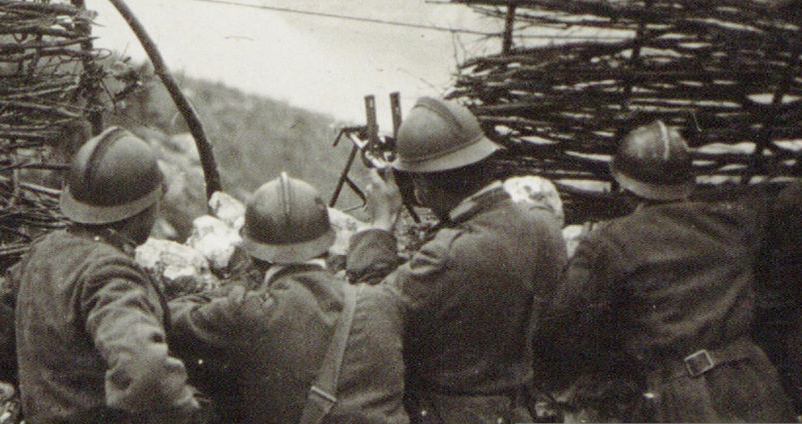

Late war machine pistol section of 1918 at the Piave, with a bipod mount replacing the earlier gun shield. The bipod was introduced at the end of 1916 in response to requests for a lighter mounting system.
The
number of machine pistols stated to be in active service by the time
of the Battle of Vittorio Veneto (24th October - 4th November 1918),
the decisive Italian offensive of the war on the Italian Front, was
5,300. It is not known whether this figure accounts for the
significant number of weapons which were allocated to be converted
into automatic carbines during the final months of the war (see: Villar Perosa carbines). The
number of machine pistols placed into service at any given time never
appears to have exceeded 5,500, likely owing to a reluctance to raise
additional machine pistol sections within the infantry battalions.
Total
production of the Villar Perosa throughout the war probably reached
around 15,000 units; the highest serial observed by the author is №
13,428 at the Royal Armouries collection in Leeds, UK.
Official orders of Villar Perosa machine guns, 1915 - 1918
| Order date | Order
expiry |
Quantity |
| 7th December 1915 |
June 1916 | 2,000* |
| 31st December 1915 |
June 1916 | 830 |
| 28th April 1916 |
October 1916 | 1,520 |
| 5th July 1916 |
October 1916 | 510 |
| 31st December 1916 |
July 1917 | 35,000 |
| 28th November 1917 |
N/A |
1,500 |
| 30th December 1917 |
May 1918 | 3,500 |
| Total | 44,860 |
Development
of Villar Perosa assault tactics
As
early as July 1916, the strengths of the Villar Perosa in a mobile,
offensive role rather than as a static defensive arm began to be
appreciated within the ranks of the 3ª
Armata, under the command of Emanuele Filiberto, Duke of Aosta. This
sentiment appears to have originated within the VI.
Corpo d'Armata, and two infantry brigades serving in this corps - the
Brigata 'Lambro' and the Brigata 'Bari' - were chiefly responsible for
conceiving the ideas under which the doctrine for the use of the
Villar Perosa would be amended later in the war.
The
Brigata Lambro (205º
& 206º
Reggimenti Fanteria), formed in April 1916 under the command of
Generale Francesco Grazioli, devised an alternate model under which a
machine pistol section was assigned at a platoon level, rather than
per company. These were known as Plotoni
Speciali ('Special Platoons') and consisted of an
'Exploratory Unit' comprising 30 infantry scouts (including 9
grenadiers) divided into three patrols of 10 men each, supported by a
machine pistol section conforming to the standard composition of 24
men and 2 guns. The deployment of machine pistol sections attached to
scouting platoons within the Brigata Lambro, often fielding these
weapons without the static shield mount, preceded the eventual
development of assault tactics for the Villar Perosa.
Composition
of the Plotone Speciale in the 205º & 206º Reggimenti Fanteria, Brigata
'Lambro' (July 1916)
| Personnel |
Rank |
Armament |
| 1 platoon commander |
Tenente |
Pistola
a Rotazione mod. 1889/ Pistola automatica mod. 1910 |
| Exploratory
Unit |
- |
- |
| 1 unit commander |
Sergente/Sergente
Maggiore |
Moschetto
mod. 1891 5 tipo SIPE hand grenades |
| 3 patrol commanders |
Caporali/Caporali
Maggiore |
Moschetto
mod. 1891 5 tipo SIPE hand grenades |
| 27 infantry scouts |
Soldati |
Moschetto
mod. 1891 5 tipo SIPE hand grenades |
| Machine
Pistol section |
- |
- |
| 1 section commander |
Tenente |
Pistola
a Rotazione mod. 1889/ Pistola automatica mod. 1910 |
| 2 gun crew commanders |
Caporali/Caporali
Maggiore |
Moschetto
mod. 1891 |
| 2 gunners |
Soldati |
Pistola
mitragliatrice mod. 1915 |
| 2 shield bearers |
Soldati |
Moschetto
mod. 1891 |
| 1 ammunition commander |
Caporale/Caporale
Maggiore |
Moschetto
mod. 1891 |
| 8 magazine carriers |
Soldati |
Moschetto
mod. 1891 |
| 12 ammunition carriers |
Soldati |
Moschetto
mod. 1891 |
The
Plotoni Speciali's deployment of the Villar Perosa in a mobile,
offensive capacity over a static defensive role was embraced by the
commander of the VI. Corpo d'Armata, Generale Luigi Capello, who in
July 1916 issued a circular entitled Riparti
Speciali Esploratori con Mitragliatrici-Pistole FIAT
('Special Exploratory Units with FIAT machine pistols') recognising
the efficacy of these new formations:
"To these special platoons of fit and
daring men will be assigned one or two "FIAT" machine pistols, with
or without shields, which will allow them, once they have penetrated
enemy positions and taken up positions on the back of them, to
integrate enveloping and annihilating maneuvers with an intense,
close and highly effective fire action against enemy units in the
rear, advancing reinforcements, flanking elements, shelters,
tunnels, caves, batteries, machine guns, bombs, etc., etc."
A
further milestone came with the publication of a paper authored by
Capitano Giuseppe Bassi of the 150º
Reggimento Fanteria. Entitled Istituzione
e impiego delle sezioni pistole-mitragliatrici
('Establishment and Implementation of Machine Pistol sections'), this
paper outlined a series of key principles by which Capitano Bassi
believed that the Villar Perosa should be deployed. Bassi argued for a
redesigning of the machine pistol sections which would be adaptive to
the practicalities of offensive infantry maneuvres. The key points
raised in Bassi's paper were as follows:
- The shield mount, which encourages stationary deployment of the Villar Perosa, should be abandoned and replaced by a lighter bipod.
- The rotating magazine retainers make reloading in combat conditions difficult; a new and simpler type of magazine catch should be introduced.
- The machine pistol section does not require the direct oversight of a commissioned officer (CO); it should be commanded by a non-commissioned officer (NCO) in order to simplify its command structure.
- The carrying chest of the Villar Perosa is heavy and easily lost in combat; it should be assigned to one of the ammunition carriers rather than the gunner himself.
- The Villar Perosa should
ideally be deployed as an offensive arm; while it can be used in a
defensive role, it is outperformed in the defense by flamethrowers
and medium machine guns.
Bassi's paper was influential on the development of machine pistol doctrine within the Italian Army and several of his key suggestions, including the redesign of the mounting system and magazine catches, rapidly came to fruition. In December 1916, a lightened bipod was adopted as the standard mounting system for the Villar Perosa and the gun shield was gradually phased out over the course of 1917. The bipod was clamped by a screw onto the muzzles of the twin barrels and could be compacted for easy and rapid transport, allowing machine pistol sections to reposition the weapon without the need to dismount it. One drawback of the bipod, however, was that it offered very little shooting support for the gunner, necessitating disciplined fire to counteract the strong recoil of the weapon during firing. By the summer of 1917, the bipod had almost completely supplanted the shield mount and the role of the shield carrier within the machine pistol sections was formally abolished.
Along
with the introduction of the bipod, a new type of magazine feed for
the Villar Perosa was standardised in 1917 which took the form of a
simple spring-loaded catch. This was placed in front of the magazine
rather than behind it, as the earlier feed rotation spurs had been;
presumably a change made so that the windows on the rear of the
magazines would not be partially obscured by the release catches. The
new type of magazine release made reloading the weapon easier and
faster, though the catches could prove delicate and prone to deformation
or breakage in rough use. An additional improvement was made to the
magazine feeds in the form of a pair of protective wings set on each
side of the feed openings in order to prevent the entry of dirt, which
also became standard on all examples of the Villar Perosa produced
with the new type of release catch. The existence of some examples
bearing protective feed wings and
the old style of rotating magazine feed indicates that a small run of
guns was produced with this feature before the introduction of the
spring-loaded release catch.


Battaglione Monte Pelmo (7º Reggimento Alpini), with off-hand Villar Perosas, July 1918. Likely part of the Battaglione Monte Pelmo's 'special platoons' modeled on the Arditi.
Subsequent
to Bassi's paper and the introduction of the bipod, a new type of
mounting system for the Villar Perosa was conceived, known as the Sostegno portatile per
pistola-mitragliatrice ('Portable support for the Machine
Pistol'). This was developed within the ranks of the Brigata 'Bari' (139º & 140º Reggimenti Fanteria)
and was an attempt to address the problem of operating the Villar
Perosa from a standing position, made difficult by the structural
design of the weapon, through the use of a special mounting system
which would be worn across the gunner's chest. The support was
effectively a wooden pannier or frame onto which the gun was fitted,
which was strapped around the neck and waist of the gunner, allowing
the Villar Perosa to be fired easily from the hip, from a standing or
kneeling stance, and for the gunner to more easily reload the weapon
or clear jams while on the move.
This invention gained the official approval of the Duke of Aosta, who endorsed the Bari support as "easy, rapid, and economical to prepare" and "very practical and destined to provide useful service". Subsequently a small batch of 66 Bari supports were fabricated by the 3ª Armata workshops, and issued to the XIV. Corpo d'Armata for field testing. The use of the Bari support by the XIV. Corpo d'Armata yielded promising results, and in June 1917 the Comando Supremo endorsed the adoption of this mount across the entire 3ª Armata and also issued instructions for samples to be distributed to all other field armies for study and evaluation. The adoption of the Brigata Bari support was not formalised at this time; rather, they were built and issued at the discretion of individual corps commands.
By the time that the Bari type
portable support had been devised, concepts of outfitting
special assault units with machine pistols had already become
widespread in various corps across the entire army. In March
1917 the 13ª Divisione Fanteria of the
XXII. Corpo d'Armata (6ª
Armata) had drawn up organisational plans for assault groups
consisting of three 8-man squads for which the efficacy of the
machine pistol was also recognised. The assault group model of the 13ª
Divisione, however, differed somewhat from other assault
formations in that the use of the Villar Perosa was
proposed to be kept separate from, though in conjunction
with, with the assault group itself:
"I
would propose that the assault units be assigned, to be used in
conjunction with them, a few machine pistols. What the enemy
lacks, we have at our disposal a weapon that is excellently
suited, due to its ease of transport and use, to the actions of
the small groups in question [...]
This weapon could continue to be an organic part of its own
section, except to receive preferential treatment from the assault
units, and to be employed with them."
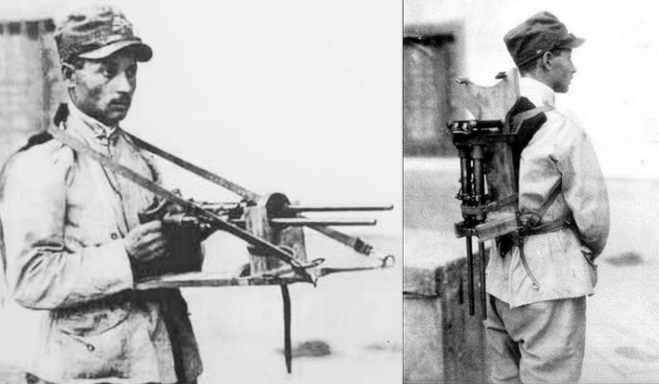


Czechoslovak Legion armed with Bodeo mod. 1889 pistols and a Villar Perosa with a Brigata Bari assault mount. Right: the Bari portable mount in service with a Reparto d'Assalto of the Alpini.
(Istituto Storico e di Cultura dell'Arma del Genio)
The organisation of special
assault and exploratory platoons within the 2ª Armata, 3ª
Armata, and 6ª
Armata precipitated the formation of the
Reparti d'Assalto ('Assault Detachments') in June 1917,
battalion-sized units intended primarily to exploit the
innovative offensive doctrines which had been promoted by
Cappello, Grazioli, and Bassi. The assault battalions existed as
semi-autonomous detachments assigned to individual army
commands, and many would later belong to a separate corps of the
army under the overall command of Generale Grazioli, the creator
of the aforementioned special platoons within the Brigata
'Lambro'. Thus these the assault battalions had greater freedom
to implement experimental formations which did not conform to
typical infantry doctrine. Immediately the distribution of
mobile supports for the Villar Perosa was given priority within
the ranks of the assault battalions; a memo dated 26th June 1917
detailing the armaments intended to be issued to these units
includes "machine pistols
with Br. Bari supports".
Suitably, the size and composition of the machine pistol sections within the Reparto d'Assalto battalions was also subject to changes from the standard framework of the infantry battalions. Initially the assault formation of the machine pistol section comprised only 12 men rather than 24, comprising 2 gunners supported by 10 ammunition carriers, who were armed as standard assault troops (a Moschetto mod. 1891 carbine and at least 6 Thévenot grenades) but issued with spare magazines for the Villar Perosa which were carried in the pockets of their tunics. There were no specifically assigned assistants to the gunners, who were expected to act with greater initiative as the sole operator of the weapon, made possible by the use of Bari type support. Additionally, training with the Villar Perosa was standardised across all assault troops, and any of the ammunition carriers within the section could be relied upon to commandeer the weapon if the designated gunner became a casualty. Within the assault battalions, these special machine pistol sections were known as 'pistolettieri' or 'pistolieri' ('gunslinger') sections, which became a popular nickname for Villar Perosa gunners. Each platoon within the assault battalions was assigned one pistolettieri section, thus greatly outnumbering the number of machine pistol sections within the infantry battalions: 16 sections armed with 32 guns within each assault battalion, compared to 3 sections armed with 6 guns in each infantry battalion.
The
typical course of instruction for the pistolettieri
sections from July - October 1917 was described in vivid detail by a
founding member of the I. Reparto d'Assalto, Tenete Salvatore Farina:
"Training for the machine pistol squad
was conducted gradually. Each squad member practiced automatic fire
from the prone position, resting the weapon on a raised piece of
ground. Next, they fired from the kneeling position, using the knee
itself to support the machine pistol. In the standing position, the
shooter initially utilized a tree or similar object for support,
before progressing to firing from a halt with arms bent - supported
by the leather sling looped around the neck - and finally repeating
the exercise while marching. Firing was carried out at ranges
varying from 300 metres down to very close quarters, engaging
targets that were initially stationary and later moving. With the
adoption of the new portable support for the machine pistol, every
squad member would be capable of firing not only while marching but
also while running."
The
12-man pistolettieri
formation did not last long and on the 21st of September 1917 it was
doubled in size to 24 men, bringing it closer in size to the standard
machine pistol sections. This did not correspond with an increase of
guns issued to the assault sections, which remained at 2. There were
also no changes to the composition, with the additional 12 personnel
simply assigned as more ammunition carriers.
It
should be noted that while Capitano Bassi's suggestion of assigning
command of the machine pistol sections to a non-commissioned officer
was adopted within the assault battalions, there was no change to the
hierarchy of the standard machine pistol sections within the infantry
battalions, which remained under the command of a commissioned officer
throughout the war.
Composition
of the Sezione Pistolettieri in the Reparti d'Assalto (October 1917)
| Personnel |
Rank |
Armament |
| 1 section commander |
Sergente
Maggiore |
Moschetto
mod. 1891 6 - 12 tipo Thévenot hand grenades |
| 2 gunners |
Caporali
Maggiore |
Pistola
mitragliatrice mod. 1915 6 - 12 tipo Thévenot hand grenades |
| 21 ammunition carriers |
Soldati |
Moschetto
mod. 1891 6 - 12 tipo Thévenot hand grenades |
The lessons of the 2ª and 3ª Armata were at this time not only embraced by the Reparti d'Assalto, but by many aspects of the wider army, including ad-hoc assault formations raised within certain regiments. As had been the case within the VI. Corpo d'Armata during 1916, the deployment of the Villar Perosa in an aggressive role within Arditi reggimentali ('regimental Arditi') was dictated largely by the individual initiative of enterprising officers. The size and composition of such assault units varied. One of the largest was organised within the 7º Reggimento Alpini, encompassing an entire battalion known as the Battaglione Monte Pelmo, in which several machine pistol sections were utilised; many experienced troops from this battalion went on to be recruited into the XXIX. Reparto d'Assalto in October 1917. Others were raised on a company or platoon scale.
The deployment of designated assault formations within regular infantry, Alpini, and Bersaglieri regiments had become relatively widespread by 1918. On the 15th June 1918, the opening day of the Second Battle of the Piave, the leader of the machine pistol section within the assault company of the 111º Reggimento Fanteria, Tenete Giovanni Paolini, commandeered his section's machine pistol and charged out of his position against an advancing Austro-Hungarian unit, "leaping alone against a group of enemies and unleashing 50 pistol shots on them, massacring the enemy and capturing some of the survivors". Paolini's subsequent attempt to perform a similar action against a better-defended Austro-Hungarian position five days later resulted in his death, and he was posthumously awarded the Bronze Star by royal decree.
The
formation of 'regimental Arditi' on a platoon scale was made official
by order of Generale Badoglio on the 26th June 1918, and subsequently
all infantry regiments were expected to raise such formations if they
had not done so already. These platoons were usually equipped with one
or two Villar Perosa machine pistols.


Left: an assault company of the VI. Reparto d'Assalto (later renumbered as IX. in May 1918), including two pistolettieri sections armed with four Villar Perosa machine pistols. Right: a regimental assault
platoon of the 33º Reggimento Fucilieri (Czechoslovak Legion), flanked by two Villar Perosa gunners.
In the
assault battalions, meanwhile, the pistolettieri
sections had become the primary bearers of the offensive firepower
during frontal attacks, softening up enemy defenses and paving the way
for the rest of the assault companies to storm these positions. A
typical offensive action conducted by the assault detachments in 1918
was described in the diary of Paolo Giuduci, who noted the role played
by the machine pistol sections during successful operations at Treviso
during the Second Battle of the Piave:
"8 June, 1918, 2:00 PM - Maggiore Ponzo calls together the company commanders of the XX. Reparto d'Assalto and orders the 1ª and 3ª Compagnia to attack across the two nearly destroyed bridges that connect the two banks of the Palumbo. They will be preceded by patrols equipped with machine pistols, which will open the gaps towards the bridges and attempt to surprise any enemy machine guns that might be targetting the exits. The 3ª Compagnia will head directly to Casa Franceschin, while the 1ª, closely linked to the right with the V. Reparto d'Assalto, which will operate between the Albera-Correggio road, will head for Capo d'Argine. The 2ª Compagnia will immediately follow the first two and reinforce the attack at points where enemy resistance is fiercest.
18 June, 1918, 4:00 PM - Everything is
ready for the attack. Today, as always, one will drives the
marvelous Arditi of the unit: that of victory. The assault patrols
are near the bridges and have already opened the passages. But the
enemy must have noticed our movement. He has, in fact, opened heavy
fire with his machine guns and effectively targets the passages.
Bullets whistle continuously. The patrols, however, do not hesitate:
they pass the chevaux-de-frise and the bridges and dive into the
fields. We follow them with our eyes. At the head of the second
there is a brave man, the adjutant-de-battle Letizia of the 3ª Compagnia d'Assalto,
who, armed with a machine pistol, proceeds, unleashing very
effective bursts."
In
addition to the Brigata 'Bari' type support, several other types of
assault mounts for the Villar Perosa were developed and submitted to
the Ufficio Tecnico in 1917. Only two were considered worthy of field
issue. A portable mounting system designed by Alberto
Capparozzo-Galli, protected by two patents of 25th August 1917 and 2nd
March 1918 ('Supporto portatile a snodo per pistole mitragliatrici'),
employed a telescoping tubular support which was affixed to the front
of special chest rigging, and offered an advantage over the Bari type
support in that it could be brought up to eye level for aimed fire.
This was proposed in tandem with magazine pouches made by the
Stabilimento Pirotecnico di Bologna, which could store 8 spare
magazines. The Ufficio Tecnico endorsed the fabrication and issue of
these mounts in 1918 as a stop-gap before the adoption of the
moschetto automatico (see: Villar
Perosa carbines), but as far as is currently known,
production of the Capparozzo-Galli mount never actually came to
fruition.
A
similar system was devised by Capitano Bassi, taking the form of a
metal bracket worn around the waist which supported a flexible swivel
mount for the Villar Perosa placed at the operator's eyeline. The
advantages of this mounting system over the prior 'Bari' type was said
to be in the ability to rotate the gun in any direction, allowing
greater maneuverability of the weapon to respond to threats from all
angles; and in the ease by which the gun could be fired from this
support while running. Tests of the Bassi type portable support were
carried out in early September 1917 at the Sdricca and Cormons firing
ranges under the scrutiny of Generale Capello and his staff, who
subsequently ordered 80 examples to be built in Udine and issued to
select units of the 2ª Armata. Among the
recipient formations was the II. Reparto d'Assalto (later renumbered
as XXII.), whose 2ª
Compagnia employed the Bassi type support in their successful assault
on Hill 814 (Vrh-Souz) at the Bainsizza plateau on the 8th October
1917; later in 1918 some were apparently issued to the XVI. Reparto
d'Assalto in Albania. Bassi's portable support, however, never came
into wider use, and it appears that most assault battalions were
satisfied with the Brigata Bari pattern support.


Right: the Bassi type portable support, adopted by assault battalions of the 2ª Armata in late 1917.
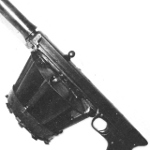
A final development in transforming the Villar Perosa into a more viable assault weapon was created at the Brescia Scuola dei Mitraglieri Fiat (Fiat Machine Gun School of Brescia) in early 1918, which constituted an attempt to mount the weapon in its entirety to a wooden shoulder stock, with a shoulder sling for transport. One contemporary photo indicates that the shape of the stock was informed by the intention of resting the gun over the shoulder of another man to provide stable support for disciplined fire. This unusual and rather ungainly looking modification was issued in May 1918 for field testing by two Bersaglieri brigades, the IV. Brigata (14º & 20º Reggimenti Bersaglieri) and the V. Brigata (5º & 19º Reggimenti Bersaglieri). It saw use by the assault detachments assigned with these brigades, the LV. and XXXI. Reparti d'Assalto, during the assault on Monte Majo on the 30th August 1918; initially successful, this operation was foiled by an Austro-Hungarian counterattack, which resulted in the capture of at least one of these weapons by the 4. Kompagnie of the Kaiserjäger-Sturmbataillon. This specific gun is today on display at the Museo Storico Italiano della Guerra in Rovereto, and bears the trophy markings 'K.J.ST.Kp. 4 - 2. Zug - Mt. Majo' ('4th Kaiserjäger-Sturmkompagnie, 2nd platoon, Monte Majo') engraved onto the stock.

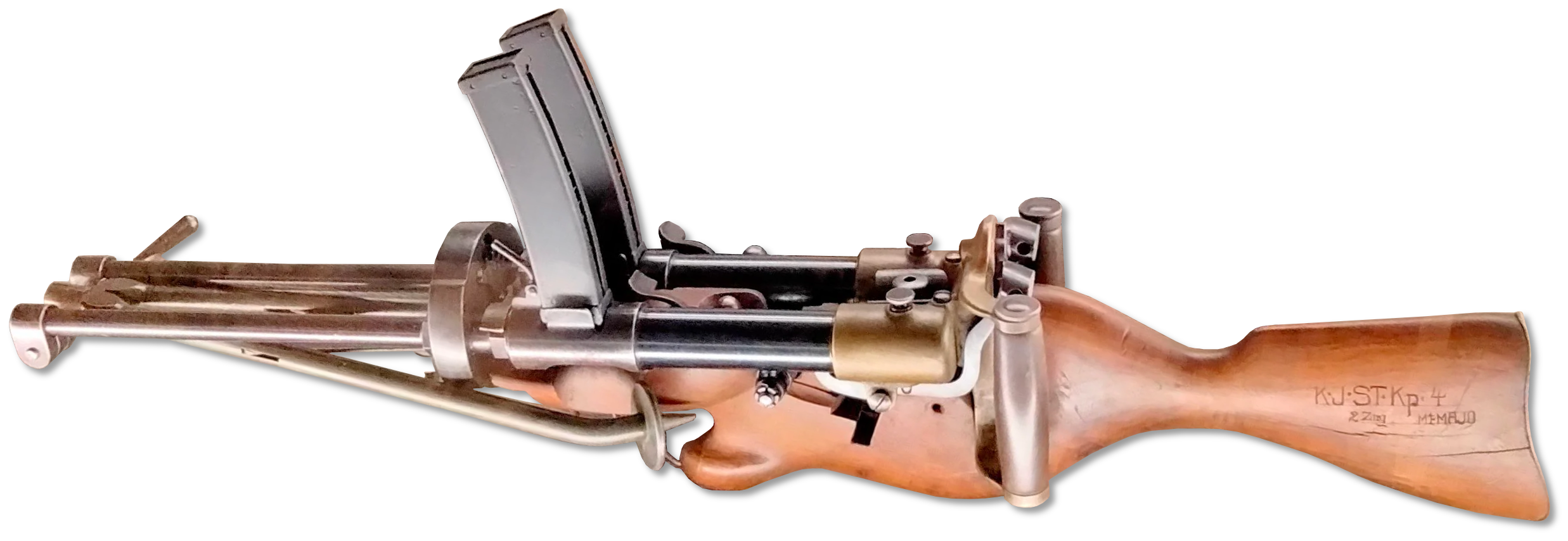
The shoulder stock for the Villar Perosa developed at the Brescia Scuola dei Mitraglieri Fiat in 1918. Small numbers of guns fitted with these experimental stocks were used in combat by the LV. Reparto d'Assalto
at Monte Majo on the 30th August 1918, during which the example shown right was captured by the 4. Kompagnie of the Kaiserjäger-Sturmbataillon.
(Museo Storico Italiano della Guerra)
The
Villar Perosa in aerial service
After an initial trial batch of 50 guns were purchased by the Corpo Aeronautico Militare in April 1915, the aviation corps followed the rest of the army in adopting the Villar Perosa at the end of 1915. Concurrently with the larger order for 1,650 guns placed for the infantry on the 7th December 1915, the aviation corps ordered 350 guns. Perhaps to encourage further interest around the Villar Perosa in an aerial role, in late 1915 the Roberto Incerti & C. company - the owner of the O.V.P. works - publicly offered prize money to Italian military aviators for scoring aerial victories.
The
Villar Perosa was initially used as an armament for the Farman MF.
11 reconnaissance aircraft. As of May 1915, the armament of an MF.
11 in Italian service consisted of four 162 mm bombs, eight 113 mm
bombs, eight 87.2 mm bombs, four hundred flechettes, one machine
gun, and one "automatic pistol
with 2 barrels (50 shots per second)".
One
of the earliest probable references to the use of the Villar Perosa
in aerial service can be found in a letter by the Italian flying ace
Francesco Baracca, dated to the 25th of August 1915, before the
weapon had come into infantry issue:
"We are on duty from dawn till dusk,
unable to step a foot outside the airfield. I’ve arranged for a
flight mechanic, Vittone, to fly as my passenger, armed with a
rifle and a machine pistol. An alarm sounds, we fly for an hour -
nothing. Who knows where the aircraft was? Perhaps one of our own;
no one recognizes or distinguishes them."
Subsequently, the Villar Perosa was fitted to a wider variety of reconnaissance planes and bombers, including the Voisin V, various Nieuport models, the Savoia-Pomilio SP. 3, and the Macchi L. 1. Exclusively in aerial service, the Villar Perosa was occasionally issued with extended magazines of a 50-round capacity rather than the standard 25, for a total of 100 rounds from both magazines.
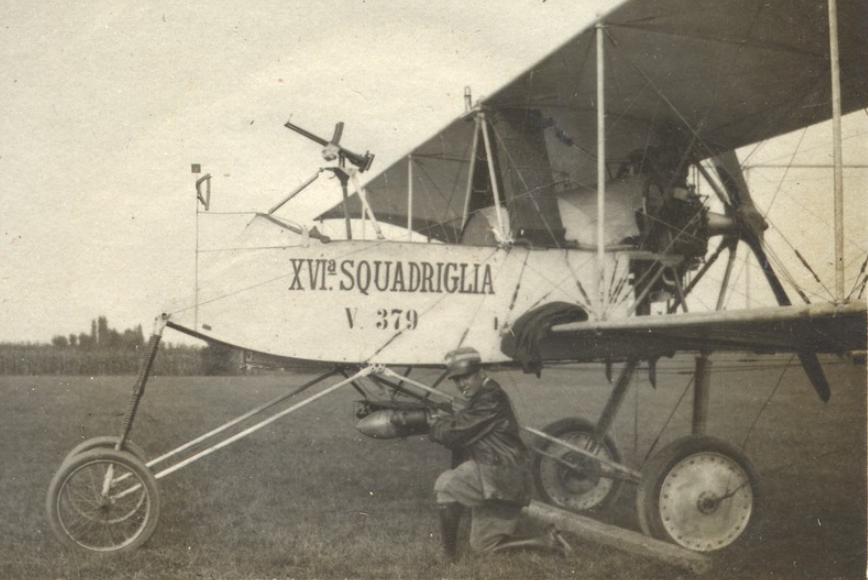
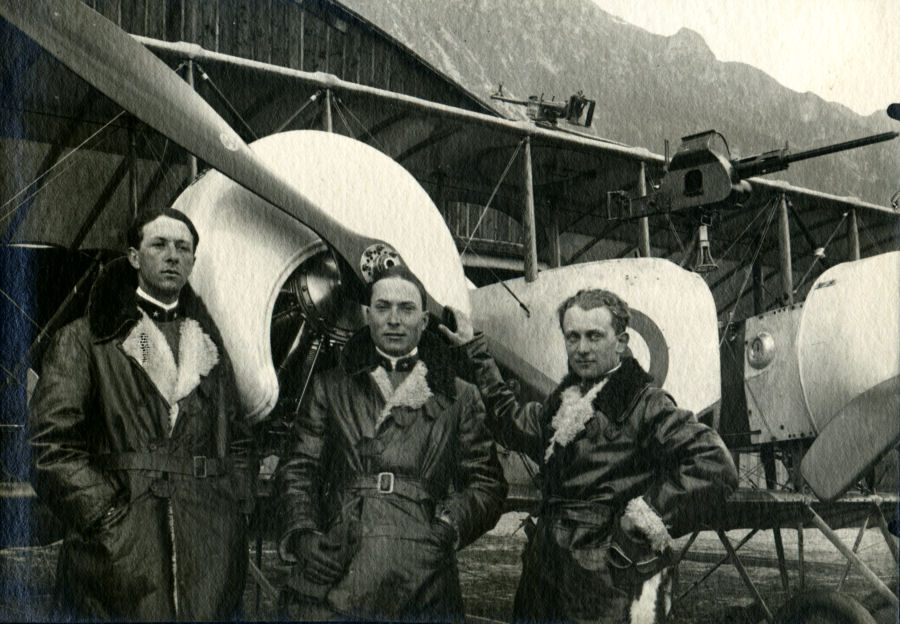
Villar Perosa machine pistols as aerial fixtures: on Voisin V
(left) and Caudron G.4 (right) light bombers, with brass-catching
devices fitted to the undersides of the receivers.
(Museo Civico del Risorgimento
Bologna)
The Officine di Villar Perosa rationalised the weapon's deployment in an aerial role as possessing equivalent firepower to a light cannon: "The volume of lead discharged by our weapon per unit of time matches that of small rapid-fire aircraft cannons". In practice this idea was flawed, as the pistol calibre ammunition of the Villar Perosa lacked the penetrative capabilities to render considerable damage to aircraft. In an attempt to remedy this, an armour-piercing variant of 9 mm Glisenti was experimentally developed for aerial use, which on testing was deemed capable of penetrating 4 millimetres of steel at a range of 10 metres. However, development of this cartridge was reportedly not completed. High-capacity magazines of 75 and 100 rounds were also evaluated by the Reparto Aereo di Artiglieria, but only the 50-round magazines were issued in any appreciable quantities.
As an early aerial armament,
however, the Villar Perosa was not completely without merit; early
military aircraft were structurally fragile, and offered little
protection for their crew. While machine pistols were largely
incapable of inflicting serious damage on aircraft, a wide volley
of fire from the Villar Perosa had a decent chance of wounding
close-flying enemy pilots or observers. It was rarely utilised as
the primary armament on Italain aircraft, instead being fitted
alongside 6.5×52
mm medium machine gun. The Villar Perosa
therefore filled a niche as a supplementary armament for aircrew,
in a similar capacity to self-loading rifles or pistols which were
also commonly carried into aerial operations.
The Villar Perosa was also commonly
employed as a fixed armament on observation balloons and
dirigibles. In this role it was usually fitted with a flexible
pintle mount. The successful use of a Villar Perosa by an
observation balloon against an attacking Austro-Hungarian aircraft
was notably recorded by the war correspondent Guelfo Civinini at
the end of 1917, published in the popular magazine La
Lettura:
"On
the 23rd of December a drachen ['dragon'; colloquial
term for dirigibles] is raised
on the swamps of the lower Piave. It has Tenete Junvenal on
board. It is a grey, cold day, foggy. Suddenly an enemy
aeroplane emerges from the fog. They quickly drop the balloon to
250 metres. The Austrian glides and attacks. It has no rockets,
but the machine gun is raging. The machine guns in the camp
respond from the ground. Juvenal does not remain idle. He takes
up the machine pistol and fires relentlessly. The Austrian
aircraft retreats. Victory! The drachen gets up sniffing the fog
and swaying happily."
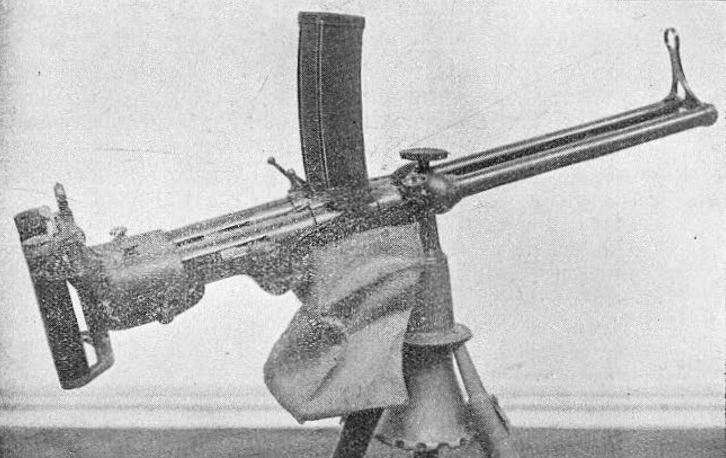

Aerial pattern Villar Perosa with flexible pintle mount, raised sights, enlarged spurs on the feed collars, and ejection bags for catching spent brass. The pintle mount was commonly used on
dirigibles and observation balloons.
The Villar Perosa as a fixed aerial
gun became technically obsolete upon the introduction of the Carabinetta Automatica O.V.P.
(see below; Villar Perosa
carbines) into aviation service in May 1918. This weapon
retained equivalent technical performance to the Villar Perosa
while taking the form of a collapsible shoulder arm, which proved
useful as an aviator's personal defense weapon. Additionally, the
introduction of the 6.5×52mm SIA mod. 1918
light machine gun in June 1918 satisfied the requirement for
an air-cooled, magazine-fed aerial armament, providing greater
ballistic power than the Villar Perosa. In aerial service the
SIA mod. 1918 was often mounted in pairs in order to emulate
the machine pistol, though few of these new guns actually came
into issue before the end of the war. Regardless, orders by
the Reparto Aereo di
Artiglieria for 1918
demonstrate the falling demand for the Villar Perosa: only 800
machine pistols were ordered that year, compared to 1,000
Lewis guns, 3,100 Vickers guns, and 8,000 Fiat-Revelli machine
guns.
Orders
of automatic weapons by the Corpo Aeronautico Militare, 1918 -
1919
| Model | Quantity |
| Mitragliatrice
Fiat-Revelli mod. 1914 |
8,000 |
| Mitragliatrice Lewis mod.
1915 |
1,000 |
| Mitragliatrice Vickers
mod. 1911 |
3,100 |
| Mitragliatrice SIA mod.
1918 |
10,000 |
| Pistola mitragliatrice
Fiat mod. 1915 |
800 |
| Carabine O.V.P. |
500 |
| Total | 23,400 |
A post-war ordnance table gives the number of "cannons and machine pistols" in service with the Corpo Aeronautico Militare by November 1918 as 2,069.
Experimental Villar Perosa mounts
Over the course of its service life, a variety of experimental mounting systems were developed for the Villar Perosa in order to adapt the weapon to a variety of combat roles. Some of these were field tested in small numbers or trialed by the Ufficio Tecnico, but were never standardised and only filled niche requirements. A few notable examples are listed here.
Tripod mounts


Left: Improvised wooden 'easel' type tripod for the Villar Perosa, developed and tested by the 52ª Divisione Alpini in early 1917. Centre: Experimental portable tripod with shoulder sling, possible Lanzoni type.
Right: Tripod stand for the pintle-mounted Villar Perosa, advertised by the Officine di Villar Perosa in 1917.
Several attempts were made by various parties to develop a light tripod mount for the Villar Perosa. The impetus for doing so was largely in an attempt to either create a lighter and less conspicuous alternative to the initial gun shield which was issued with the Villar Perosa, or to improve upon the poor shooting support offered by the later bipod mount which was standardised in 1917.
One
of the earliest attempts to develop a tripod mount for the Villar
Perosa was conceived in early 1917 by the 52ª
Divisione Alpini, constituting an improvised
wooden easel. However, this model proved inadequate when subjected
to testing at a course in assault tactics on the 7th of May, due to
the inability to properly secure the gun to the mount during firing.
A similar easel-style tripod was also constructed in a sturdier iron
iteration, weighing 3 kg (6.6 lb), was subsequently developed at a
repair workshop in Enego, and issued on a trial basis to machine
pistol sections of the 6ª Armata in the spring of 1917;
this proved well-received, though was never taken into service
on a wider scale.
A
portable tripod with adjustable legs and a shoulder sling for rapid
transport was proposed to the Ufficio Tecnico and subjected to
testing, but was not adopted; this was possibly the type patented by
Giorgio Lanzoni on the 7th August 1917. A simple metal tripod also
appears to have been proposed in conjunction with the
Capparozzo-Galli telescoping portable mount in 1918 (see: Development
of Villar Perosa assault tactics).
Another
type of tripod, intended for use in conjunction with the flexible
pintle mount used in the aerial configuration of the Villar Perosa,
was advertised by the Officine di Villar Perosa itself in its
English-language marketing brochure. This type was possibly only
intended for demonstration of the aerial configuration weapon
without the necessity of mounting it to an actual aircraft.
Bicycle mounts
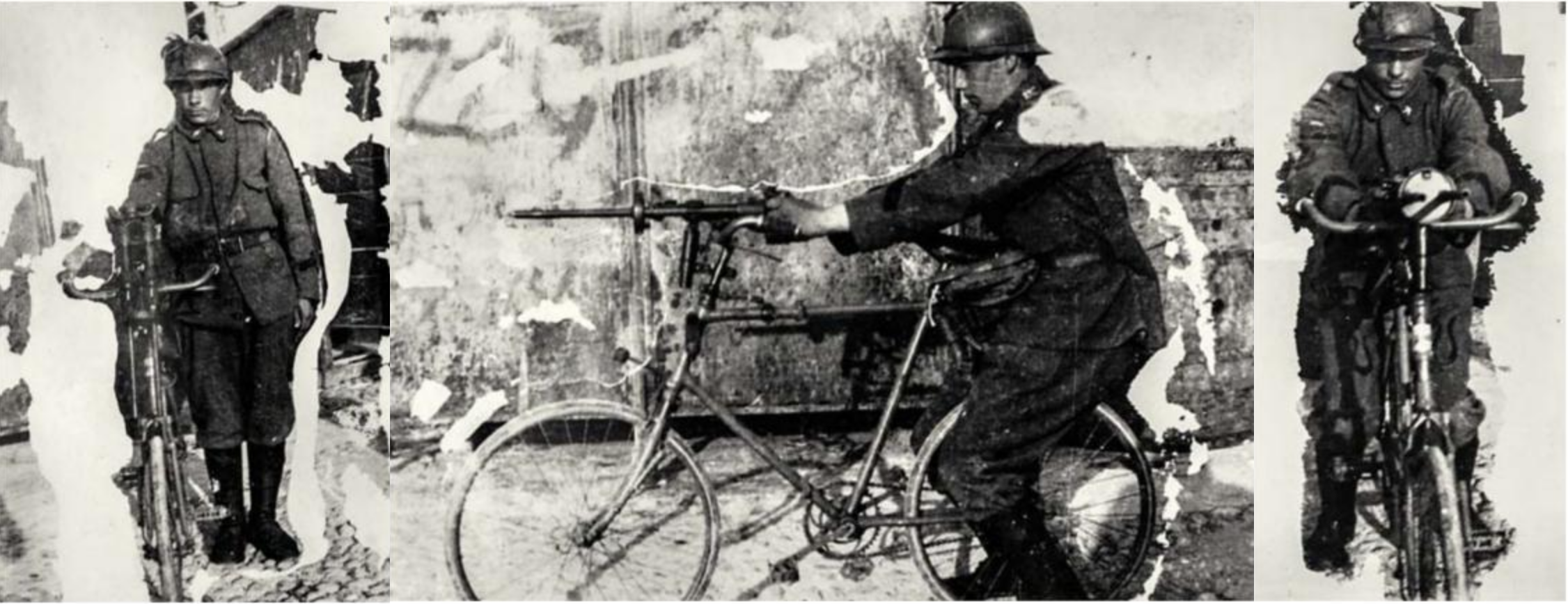

Left and centre: The Vincitorio bicycle mount for the Villar Perosa, tested by the Bersaglieri in 1918 but not adopted. Right: Unidentified bicycle mounting system for the Villar Perosa.
(Left: Museo Storico dei Bersaglieri)
(Right: US Army Ordnance Museum)
Likely
in response to a requirement created by the Bersaglieri and
possibly the cavalry, a number of mounting systems designed to
adapt the Villar Perosa to be fitted to the handlebars of the
Bianchi mod. 1912 bicycle were developed around 1917 - 1918. The
Villar Perosa must have been considered ideal for affixing to a
bicycle since it was light, compact, and did not require precision
to be used effectively. One such device was patented by Alberto
Capparozzo-Galli on the 2nd of March 1918, constituting a
swivel-joint which clamped to the receiver of the weapon. This
would subsequently serve as the basis for Capparozzo-Galli's
experimental 'walking fire' support (see: Development
of Villar Perosa assault tactics). Another similar model
known as the Vincitorio type was tested by the Bersaglieri.
A third type of bicycle mount for the Villar Perosa, of unknown origin, is seen depicted in a photograph in the collection of the US Army Ordnance Museum. The context under which this model was made is unknown, though the photograph's existence in a US archive and the mount's current presence in the collection of Hollywood film armourer company Bapty & Co. suggest the possibility that this mount was demonstrated experimentally for US or British military use.
'Self-propelled
tripod'


Italian infantry training with the Villar Perosa in the 'self-propelled tripod' configuration, mounted to the back of one man and operated by another.
(Museo Civico del Risorgimento Bologna)
An
unorthodox firing technique instructed at infantry training
courses during 1918 was that of the 'self-propelled tripod'; a
method in which the Villar Perosa, affixed to a 'Bari'-type
portable support, was worn around the back of one man who himself
provided the support from which the gunner fired the weapon. It is
unlikely that this method was practically applied in combat.
Dubious 'Marazzi' aircraft mount
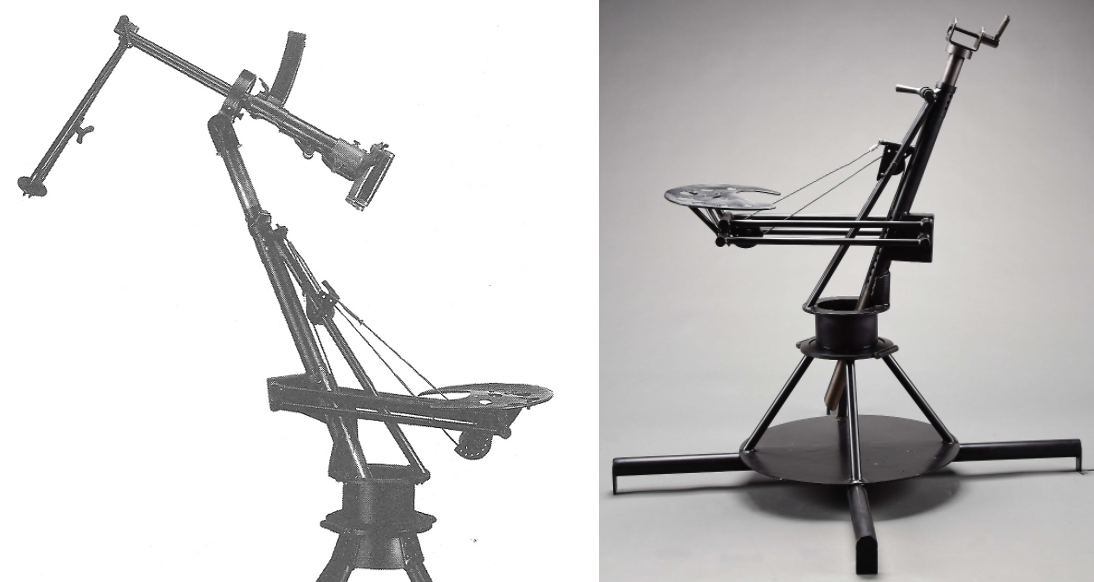
A modern replica of the Marazzi patent adjustable anti-aircraft mount, fitted with a Villar Perosa in the infantry configuration. There is no known record
that this pattern of mounting system was employed by the Italian Army during the First World War.
(Morphy Auctions)
Subject of a 1925 patent by
Ettore Marazzi, this was a seated anti-aircraft mount for use on
planes and boats. The Marazzi system gave variable elevation
through pressure exerted onto the gunner's seat. A modern
reproduction example in a United States private collection has
been described by an auction house as a "reproduced
bomber or boat mount for the Italian Villar Perosa machine
gun... true to the original design". This reproduction
mount has been coupled with a Villar Perosa of the typical
infantry configuration, with bipod; modification of the weapon via
the addition of a hinge to the underside of the front sight
bracket has been undertaken to adapt the weapon to the mount, as
it certainly would not have been compatible otherwise. Therefore
it cannot be said that this mount was designed with the Villar
Perosa in mind, and moreover Marazzi's patent drawing in fact
depicts the mount being used in conjunction with a Fiat-Revelli
mod. 1914 medium machine gun. There is no known evidence that this
mount was ever used for the Villar Perosa during the First World
War.
Villar Perosa carbines
Beyond methods of adapting the Villar Perosa for different roles though experimental mounts, there were also concerted efforts during the First World War to convert the Villar Perosa from a twin-barreled mounted weapon into a single-barreled shoulder arm, more in line with the modern concept of a submachine gun. It appears that first individual to conceive this idea was the designer of the Villar Perosa itself, Bethel-Abiel Revelli, who included a passage in the original 1915 patent for the weapon which read "the gun with one or more barrels may be mounted after the manner of a rifle in order that it may be fired from the shoulder". However other attempts were subsequently made by Alfredo Scotti, Amerigo Cei-Rigotti, Tullio Marengoni, the Tappari brothers, and several other engineers. The Italian Army expressed great interest in this concept during the later stages of the war, and applied it for both aerial and infantry use.
The
Carabinetta Automatica O.V.P.
In
December 1916, the Reparto Aereo di Artiglieria commissioned
Bethel-Abiel Revelli to develop a potential replacement for the
Mauser C96 (Pistola automatica mod. 1899) then in service with the
Corpo Aeronautico Militare. Rather than designing a new pistol, in
January the next year Revelli presented to the aviation corps a
single-barreled automatic carbine based on the Villar Perosa,
which he had already designed with infantry use in mind. The
Officine di Villar Perosa acquired a patent protecting Revelli's
new carbine by the 10th of March 1917. Certain aspects of the
design, including the placement of the magazine, the barrel
length, and the presence of a ventilated barrel shroud, were
amended in the finalised design, which had been completed by 1918
and was referred to as the Carabinetta
Automatica O.V.P. (sometimes rendered simply as Carabine
O.V.P.).
The
Carabinetta Automatica operated on a blowback action employing the
same inertial locking principle as the Villar Perosa. It fired
from a pair of triggers which gave uninterrupted automatic fire
from the forward trigger and single shots from the rear trigger.
Though commonly reported to be a conversion of the Villar Perosa,
in fact the Carabinetta Automatica O.V.P. shared no components
with the original Villar Perosa except for the magazine. A
unique feature of the O.V.P. was the use of a knurled retracting
sleeve which enveloped the receiver as the means of cocking the
weapon. This did not reciprocate with the bolt on firing. A basic
two-stage sighting system was mounted to the left side of the
receiver and barrel. The wooden buttstock of the O.V.P. was
detachable; the weapon was effectively a compacting takedown gun
which was intended to be stored in a collapsed state before use,
and in keeping with this it was manufactured with a wooden
carrying case, similar to that of the Villar Perosa.
Though never seen on surviving examples today, the O.V.P. was also originally designed to mount a detachable foregrip on the underside of the ejection opening, which was hollowed-out so that it could double as a brass collecting device for spent cartridges, undoubtedly a feature requested by the Corpo Aeronautico Militare for aerial use. A hinged opening was fitted to the base of the foregrip so that the collected casings could be quickly dispensed without removing the entire grip. Practically all of these special foregrips must have been disposed of at some point as none are still known to exist.
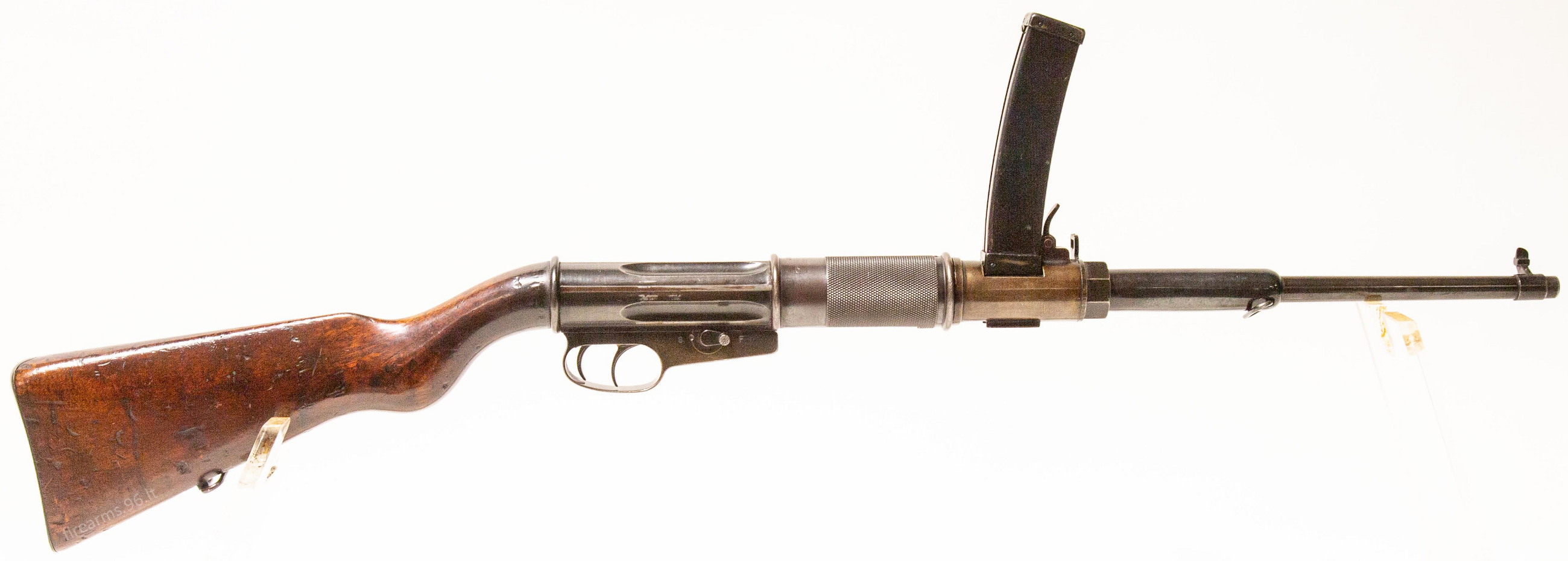
The
Carabinetta Automatica O.V.P., conceived at the end of 1916 and
adopted by the Corpo Aeronautico Militare as an aviator's
armament in 1918.
(Author's photo via Royal
Armouries Collection)
The
Carabinetta Automatica O.V.P. was taken into service with the
Corpo Aeronautico Militare and the Aviazione Navale in May 1918,
with 500 guns being delivered over the course of the year. These
were issued to aviators during the final months of the war, though
the extent to which they saw use in aerial combat is unclear. In
any case it is known that one such gun was issued to the famous
Italian pilot Antonio Locatelli, who carried an O.V.P. during
observation flights in late 1918. His personal O.V.P. carbine
(serial ) is currently on display at the Museo Storico Italiano della
Guerra in Rovereto.
Brief consideration appears to have been given to issuing the Carabinetta O.V.P. to infantry troops, as per Revelli's initial intention. It is reported that the I. Reparto d'Assalto established special patrol of 40 men issued with these guns in the summer of 1918 and used them in combat during the raid at Casa Forzellette of Monfenera on the night of the 20th - 21st September. However, any further consideration for the distribution of O.V.P. carbines in a terrestrial capacity was likely abandoned upon the adoption of the Moschetto Automatico Revelli-Beretta (see below) during the same month.
The
Carabinetta O.V.P. practically supplanted the use of the
fixed-mount Villar Perosa as an aerial arm within the Corpo
Aeronautico Militare, and remained in service following the
establishment of the Regia Aeronautica in 1923. These guns were
still in use by the time of the Second Italo-Ethiopian War (3rd
October 1935 - 5th May 1936), where they appear to have been used
by both sides; some guns fell into the hands of the Ethiopian
Army, probably through Italian arms sales in the late 1920s.
Additionally, the Italian communist dissident Ilio Barontini was
photographed wielding an O.V.P. carbine while fighting alongside
Ethiopian militants against the Italian Army in the late 1930s.
The Moschetto Automatico
Following
the development of the Carabinetta Automatica O.V.P., investigations
were made into actually repurposing existing Villar Perosa machine
pistols into single-barreled shoulder arms, as opposed to the
production of a new weapon from scratch. The first proposal along
these lines was made to the Ufficio Tecnico in 1917 by Amerigo
Cei-Rigotti, who presented his design for a 'moschetto
mitragliatrice' ('machine carbine') in two models, intended for
infantry and aerial use respectively. Cei-Rigotti's idea, later
patented on the 2nd January 1918, was to fit a single isolated
Villar Perosa receiver onto a wooden buttstock (patterned after that
of the Moschetto mod. 1891 Truppe
Speciali) with a new trigger group, to effectively convert
the weapon from a mounted weapon into a handheld carbine. The Moschetto mitragliatrice Cei-Rigotti
was subjected to trials in September 1917, but was at that time not
well-received by the Ufficio Tecnico owing to concerns about the
practicality of reorganising the existing machine pistol sections to
accommodate the conversion of Villar Perosas into these new
automatic carbines.
By
early 1918, however, similar ideas began to emerge organically from
troops at the front; Maggiore Alberto Neri of the 7º
Reggimento Alpini had conceived his own 'moschetto automatico' which
was subsequently produced in a limited run of 100 units and issued
for field testing to the 4ª
Armata. Several other proposals followed, including
designs by private inventors Pasquale Mega, Ernesto Troiano, and
Luigi & Alberto Tappari. In response to the growing demand for
an automatic carbine in Italian service, the Ufficio Tecnico
commissioned the Manifattura Italiana d'Armi (MIDA) and Fabbrica
d'Armi Pietro Beretta, both of Brescia, to develop their own
'moschetto automatico' prototypes for comparative testing. Though
these weapons were initially designed as selective-fire weapons, by
the 12th September the Ufficio Tecnico, under the advisement of
Generale Badoglio, had decided against the inclusion of
uninterrupted rapid fire due to the excessive fire rate generated by
the Villar Perosa's action, and the finalised designs for both guns
were only capable of semi-automatic fire.


Early
'moschetti mitragliatrici' field tested by the Italian Army in the
spring and summer of 1918: the model of Alberto Neri (left),
issued in 100 units to the 4ª
Armata; and the 'Savoia' model by MIDA,
issued in 300 units to various units, including the Corpo
d'Assalto d'Armarta.
By
the 13th June 1918, the requirement for an automatic carbine became
official as the Comando Supremo drew up plans for the complete
reorganisation of the infantry under the proposed 'Battaglione Tipo'
model, in which the standard infantry company as it existed prior
would be reorganised into the 'Compagnia Moschettieri' ('Musketeer
Company'), which comprised three platoons, each containing one
'squadra moschetti automatici' equipped with two automatic carbines.
Thus, each infantry battalion would contain 6 automatic carbines per
company, for a total of 18 guns across the battalion, and 54 guns
across an entire regiment. The Battaglione Tipo model made no
allowance for the continued existence of the machine pistol sections
armed with the Villar Perosa, which were ultimately intended to be
abolished.
After brief deliberation on which model would be taken into service, the Beretta design was given preference, and taken into service as the Moschetto automatico Revelli-Beretta. On the 14th September 1918 the Ministero delle Armi e Munizioni (Ministry of Arms & Ammunition) reached an agreement with Pietro Beretta for his company to convert 5,000 Villar Perosa machine pistols into 10,000 Revelli-Beretta automatic carbines. MIDA and the Fabbrica d'Armi di Brescia were subcontracted to produce certain components for the weapon. Production began immediately, and in early October a training course for the use of the automatic carbine was established at the Scuola Centrale di Fanteria in Civitavecchia; though this new model for the army could not be implemented prior to the imminent Battle of Vittorio Veneto (24th October - 4th November 1918).
Despite the ambitious plans for the replacement of the Villar Perosa with this new weapon, the war on the Italian Front ultimately ended before the Revelli-Beretta carbine could come into appreciable frontline service. Whether any of these carbines were deployed in combat at all is a matter of controversy and has not been definitively determined; whatever the case, its application was so limited that Generale Grazioli felt confident in writing in 1921 that the Revelli-Beretta had only been used in training. Upon the signing of the Armistice of Villa Giusti on the 3rd November, Generale Badoglio immediately ordered Beretta to pause all production of the Revelli-Beretta; only 1,400 guns had been made to that point, converted from 705 Villar Perosas. With the total cessation of hostilities by the 11th November, the requirement for the Revelli-Beretta disappeared and as far as is known, production was never resumed. Additionally, the planned Battaglione Tipo model for the reorganisation of the army was never implemented on a complete scale, and consequently no 'moschettieri' companies were ever raised outside of Civitavecchia.

The
Moschetto Automatico Revelli-Beretta mod. 1915, adopted towards
the end of 1918. This was effectively a single-barrelled,
semi-automatic Villar
Perosa fitted to a wooden buttstock with a folding bayonet.
(Author's photo via Royal Armouries Collection)
Experiments
with the automatic carbine models Revelli-Beretta, Savoia, A.N., and
Ansaldo Crocetti continued into the early 1920s, when the moschetto
automatico itself was due to be replaced by an automatic rifle
chambered in an intermediate catridge (the 'Moschetto automatico per
Fanteria'). One such proposal to meet this demand was developed at
the Fabbrica d'Armi di Brescia, designated as the Moschetto
automatico per Fanteria tipo 'Brescia', which was a development of
the Revelli-Beretta rechambered in a 7.65×32 mm cartridge and fed by a staggered
magazine loaded into a lateral feed system imitating that of the
Fiat-Revelli mod. 1914 medium machine gun. The Tipo 'Brescia'
automatic carbine was abandoned in favour of a superior model by the
Fabbrica d'Armi di Terni, but this itself languished in uncertain
status for years until it was finally cancelled in 1928, ten years
after the end of the war.
Those
Revelli-Beretta carbines that were produced before the armistice
remained in limited service throughout the 1920s, but with no clear
application for them, the Italian government soon began to seek ways
to offload them to friendly nations; Mussolini ordered a quantity to
be sold to the Ethiopian Kebur
Zabagna in January 1928 as part of the Italo-Ethiopian
Treaty of Friendship (variously reported as 48 or 350 guns), while
others were placed into service with the Regio Corpo Truppe
Coloniali and issued to Eritrean troops. A further batch of guns
were sold to Saudi Arabia during an Italian military mission to
Jeddah in 1938. By 1943, the Italian Army had only 63 guns left in
inventory, and following the German invasion of Italy in September
that year the Revelli-Beretta played no major role in arming either
the collaborationist forces of the Axis-aligned Social Republic or
the Allied royalist co-belligerent army, though a small number of
weapons found their way into the hands of the Comitato di
Liberazione Nazionale (CLN), the Italian resistance movement.
The
Austro-Hungarian response
"I liked it very much, the Italian machine pistol."
The
Austro-Hungarians initially encountered the Villar Perosa machine
pistol during the Battle of Asiago, and by June 1916 had captured
small quantities of this new weapon. Initially assumed to be a
French design, tests of a sample obtained by the XVI. Korps were
conducted at the K.u.K. Artilleriearsenal on the 11th July 1916.
After deliberation on the possibility of developing a similar
weapon for Austro-Hungarian service, the K.u.K.
Kriegsministerium (Imperial & Royal War Ministry)
began to make enquiries to various arms manufacturers about the
fabrication of a machine pistol in November 1916.
Though at least one enterprising officer of the Standschützen had conceived a machine pistol or submachine gun concept as early as October 1915 in the form of the Maschinengewehr Hellriegel, this never gained any traction within the Austro-Hungarian Army, and instead all Austro-Hungarian developments in the field of machine pistols were directly informed by the Italian weapon, which had a proven record in combat. At least three arms manufacturing firms in Austria-Hungary were commissioned to meet this requirement: Österreichische Waffenfabriks-Gesellschaft (ŒWG) of Steyr; Fegyver- és Gépgyár (FÉG) of Budapest; and Škoda-Werke of Plzeň. All three firms had fabricated prototypes of their respective designs by March of 1917. ŒWG and FEG had approached the task with the idea of converting existing pistols in their product lines into selective-fire machine pistols, which were fitted in pairs to special mounts in order to conceptually imitate the Villar Perosa, but bore no similarities to the Italian weapon mechanically.

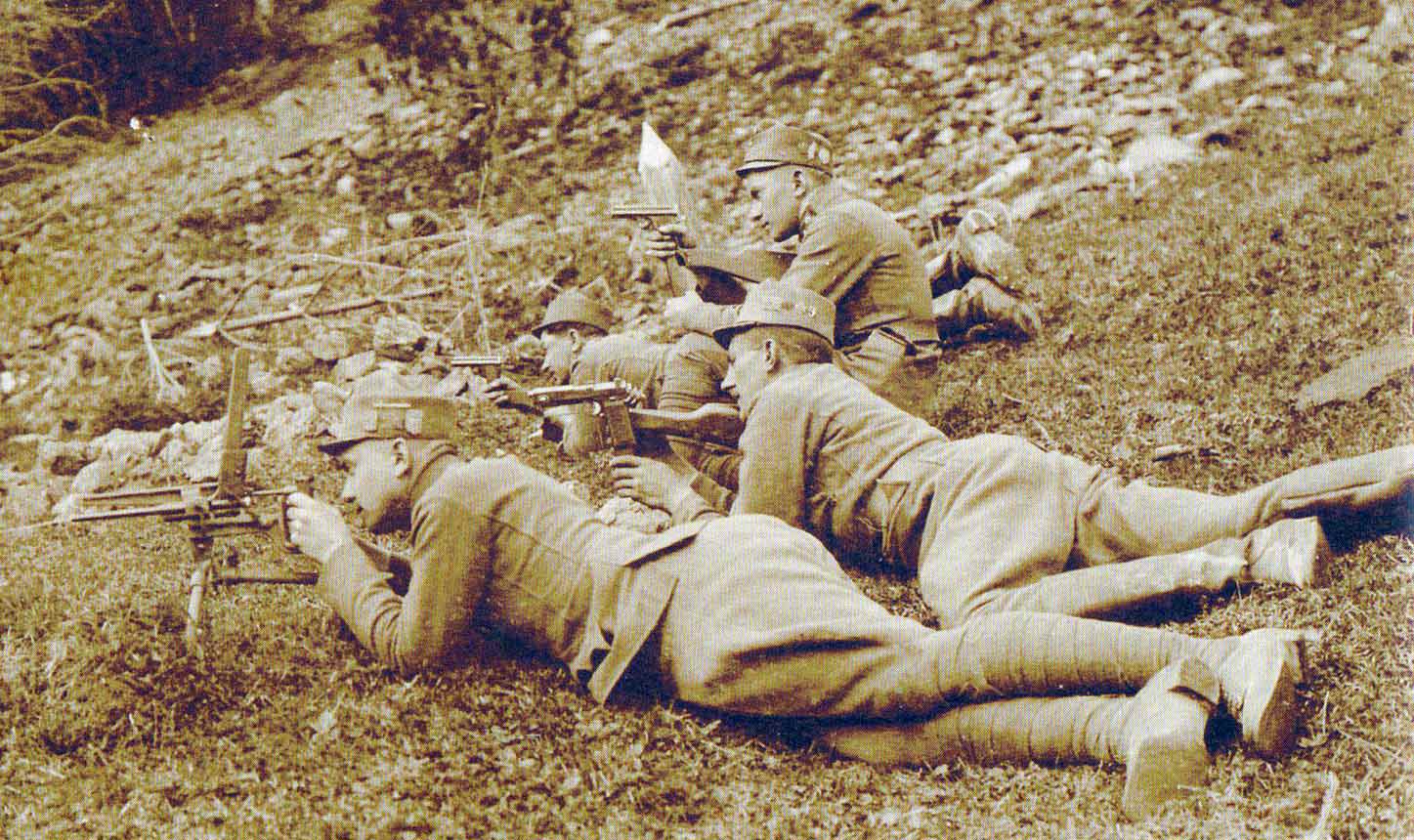
Left:
An Austro-Hungarian Feldwebel demonstrating the Villar Perosa to
Kaiser Karl I and Generall Conrad von Hötzendorf, 1917. Right:
Austro-Hungarian mountain troops in early 1917 testing the
prototype
Pistolen-Maschinengewehr (left) and the Doppelpistole (center),
two domestic attempts to imitate the Villar Perosa.
(Österreichische
Nationalbibliothek)
The Sturmpistole M.18

The Austrian 'Sturmpistole', developed in 1917. This was a straight copy of the Villar Perosa in 9×23 mm Steyr, produced at Škoda-Werke
in Plzeň and issued to special machine pistol squads.
(Museo Nazionale di Castel Sant'Angelo)
Though the Sturmpistole gave mixed results during testing at the K.u.K. Artilleriearsenal in the summer of 1917, it was recognised as a more promising proposal than those of ŒWG and FÉG, whose commitments to the manufacture of existing ordnance was in any case too great to take on the production of a new weapon. Therefore the Kriegsminiterium cancelled work on the ŒWG and FÉG machine pistols and devoted all necessary attention to the adoption of the Sturmpistole. In anticipation for the imminent offensive at Caporetto in October, the Kriegsministerium immediately distributed a small batch of 50 guns to select divisions of the 1. Isonzo-Armee for field testing; though some of these guns were transferred with their respective units to the German 14. Armee. Two known recipient regiments of these trial guns included the Infanterieregiment Nr. 18 'Erherzog Leopold Salvator' (14. Armee) and the Gebirgsschützenregiment Nr. 1 (formerly Landsturmregiment Nr. 11, 1. Isonzo-Armee).
To
accomodate the issue of the Sturmpistole, the Kriegsministerium
drew up a proposal for the formation of machine pistol squads
which would be armed with these guns, known as the Sturmpistolenpatrouille.
It was conceived that these formations would be raised on a
platoon level, with each infantry platoon being assigned 2 guns;
though the allocation and maintenance of machine pistols was to be
the responsibility of the company Handmaschinengewehr-Zug (light
machine gun platoon), under which the Sturmpistolenpatrouille were
officially subordinated.
Composition of the
Sturmpistolenpatrouille (1918)
| Personnel |
Rank |
Armament |
| 2 gunners |
Mann (Private) |
Sturmpistole M.18 (264 rounds 9×23mm) |
| 2 ammunition carriers |
Mann (Private) |
Repetiergewehr M.95 (40 rounds 8×50mmR, 952 rounds 9×23mm) |
The existence of the Sturmpistole
was immediately disclosed to the Italian 2ª Armata by a pair of
Czech deserters from the II. Bataillon of the IR 18 on the 21st
October, just two days before the offensive commenced; an
intelligence report compiled by the 2ª related that of the nine
guns received by the II./IR 18, most had been plagued with
faults and only one functioned as intended. These weapons were
nevertheless likely used in combat by the II./IR 18 at Gabrje
(24th October) and by the G.Sch.R 1 at Zenson di Piave (12th
November), but troop reports compiled during the otherwise
successful offensive indicated that some of the Sturmpistole
sections raised within the recipient divisions had opted to
replace their guns with Villar Perosa machine pistols captured
from the Italians, owing both to the poor reliability of the
Austro-Hungarian weapon and shortages of 9×23
mm ammunition. Most of the faults appear to have originated with
the magazines.
After further refinement of the Sturmpistole during the spring of 1918, the Kriegsministerium was satisfied with the weapon and decided on its adoption, with an order for some 40,000 guns being placed, though this was quickly revised to 20,000 guns. To ease the pressure on the Škoda-Werke in fulfilling this large order, the ŒWG in Steyr, FÉG in Budapest, and WHF in Vienna were subcontracted to assist in the production of the Sturmpistole. However, the vast majority of these weapons never materialised as Škoda encountered difficulties completing the machine tooling required for mass production, in addition to shortages of resources and balancing the order with other high-priority war materiel. Those few guns which were produced by the summer of 1918 were distributed sparingly to select units, including the Kaiserjäger-Sturmbataillon, from around August - September. Some of the guns that did make it to the front were captured in battle by the Italians during the Battle of Vittorio Veneto, and as a consequence several surviving examples exist today in Italian museums.
Mass-scale production of the
Sturmpistole never commenced before the armistice of 3rd
November; Mötz & Schuy estimate that only around 250
units were completed before the end of the war. The British
officer Robert Kenneth Wilson, writing in 1935, indicated
through an unnamed Austrian source that the the machine
tooling for the production of a machine pistol had been
completed at the ŒWG by
November of 1918,
but was subsequently destroyed by the Inter-Allied
Commission of Control after the Armistice of Villa Giusti.
Austro-Hungarian and German aerial mounts
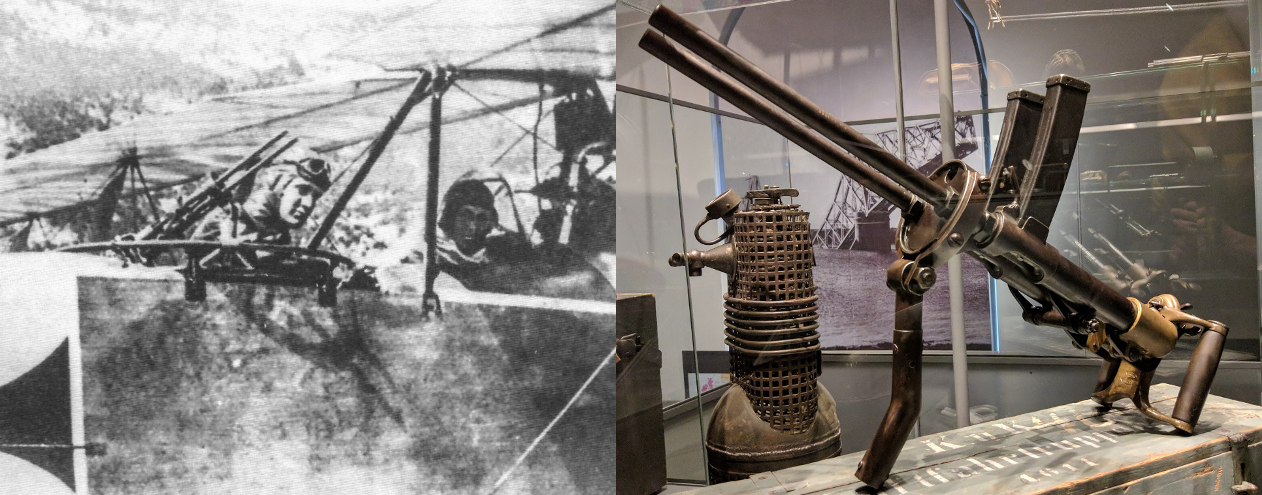
Left, a captured infantry pattern Villar Perosa mounted to an Austro-Hungarian Phönix C.1 reconnaissance plane in 1918. A similar type of improvised aerial mounting is seen centre
at the Heeresgeschichtliches Museum in Vienna. Right, another mounting system devised for Austro-Hungarian aerial service.
(Heeresgeschichtliches Museum)
The
Austro-Hungarians, like the Italians, employed the Villar Perosa as
an aerial machine gun on some of their aircraft. Official K.u.K.
records indicate that 14 such guns were fitted to aircraft in 1916.
However since the overwhelming majority of Villar Perosa machine
pistols in Austro-Hungarian service were of the terrestrial
configuration, they lacked the necessary features to be fitted to
aircraft and had to be adapted to aerial use using special
improvised mounts. The Austro-Hungarian method of achieving this
appears to have been through screwing a bracket to the central disc
socket which was attached to a hinged stand. The stand would be
fitted to the aircraft.
This practice of mounting captured infantry pattern Villar Perosas to aircraft was also adopted by the German Luftstreitkräfte, likely during 1918 following the German intervention on the Italian Front. An undated photograph depicts a Halberstadt CL.II of the Fliegerabteilung (A) 219 fitted with three Villar Perosas using improvised tripods.
Foreign
trials of the Villar Perosa
British
trials
In late 1915, the Officine di Villar Perosa sent a sales representative, Signor Bernachi, to the UK in an attempt to secure export sales to the British Army. An initial demonstration of the Villar Perosa was undertaken at the School of Musketry in Hythe on the 7th of October. Though this test was brief, with only 200 rounds fired, the weapon made a decent impression on the observing officers in attendance, with the Commandant of the School observing that "the weapon would probably be a very useful addition to the armament of infantry in European warfare; especially for trench work." A representative from the Royal Flying Corps, Lieutenant Colonel Charles Longcroft, expressed interest in ordering a sample for separate trials within the RFC.
Ten days later, on the 18th October, a second and more detailed trial was conducted at the Royal Small Arms Factory at Enfield, with the Chief Inspector of Small Arms (CISA) in attendance. The CISA’s subsequent report raised four key criticisms of the design:
- The rate of fire is too fast, and should be reduced by either increasing the weight of the bolt or altering the design of the locking mechanism.
- The ejection system is not reliable as a consequence of the rapid fire rate; this could be remedied through the same means as above.
- Accuracy is poor due to the rear mounting system offering inadequate support against the recoil of the gun; this could be amended by either moving the mounting point further forward to provide better support, or by mounting the gun to a shoulder stock.
- The left bolt handle is difficult to reach as it directly faces the right receiver; this could be amended by repositioning the bolt handles to the top of the top of the receivers where they can be easily reached.
Despite
these reservations, the CISA believed that the Villar Perosa was
conceptually a worthwhile armament and recommended a redesign of the
weapon in order to improve its viability. He considered that the
Villar Perosa would benefit from the addition of a shoulder stock, a
twin trigger group in the manner of a double-barrelled shotgun, and
a forward grip attached to the barrels.
On
the 6th of November 1915, the Villar Perosa returned to the School
of Musketry at Hythe for ballistic tests. It should be noted that in
this test, as in all the aforementioned demonstrations in Britain,
the Villar Perosa was fired using German 9 mm Parabellum ammunition,
rather than the Italian 9 mm Glisenti cartridge for which the weapon
was originally designed. No issues were reported from this. The
ballistic tests determined that the weapon produced penetration of
about 4.75 inches (120 mm) against sheets of pinewood, with bullet
trajectories of 2.5 feet at 50 yards; 3.8 ft at 100 yd; 4.5 ft at
150 yd; 4.3 ft at 200 yd; 3.3 ft at 250 ys; and complete drop-off at
300 yd.
The Commandant of the School of Musketry concurred with the assessment of the CISA that the weapon should be redesigned to take a buttstock and twin trigger group. On the 13th November the School forwarded a sample of the gun to the General Headquarters (GHQ) in France, along with 250 rounds of ammunition. An additional supply of ammunition was requested by the GHQ on the 10th of December so that tests could be extended, but the ultimate conclusion reached by the GHQ on the 29th January was that the introduction of another type of machine gun into British service would not be desirable; the Lewis machine gun had just recently come into service and there was little appetite to place further pressure on logistics. Additionally, the GHQ did not consider that the Villar Perosa should be adopted by the RFC.

Unique model Villar Perosa chambered in .455 Webley Automatic, probably built on the request of the Royal Flying Corps in 1916.
(Author's photo via Royal Armouries Collection)
Note must be made of the existence of a special model of the Villar Perosa chambered in the .455 Webley Automatic cartridge, which today exists in the collection of the Royal Armouries in Leeds, UK. This gun, which is built in the standard aerial configuration with raised aperture sights and a flexible pintle mount, takes a pair of straight box magazines which are canted at a slight rearwards incline, and possibly take a capacity of 50 rounds each. Smaller 25-round versions also appear to have been made for this gun, at least one of which exists in a private collection in the US. The magazine feeds are of the later type, using spring-loaded release catches with protective wings, though it is notable that the catches are enlarged in size compared to the standard model Villar Perosa, probably to accommodate for aviators wearing thick gloves.
This gun is mentioned nowhere in the reports published by the Small Arms Committee, and it must be assumed that it was built at some point later than 1915. It is very likely that this model was built on the request of Lieut. Col. Longcroft, as alluded to in the report made at the School of Musketry on the 7th October; however it is also probable that by the time it arrived in Britain, any serious consideration for the adoption of the Villar Perosa by the RFC had past and therefore the weapon may have never been subjected to anything more than a token demonstration.
North
American exports
The Villar Perosa was offered to the US Army Ordnance Department via the American military attaché in London on the 8th of September 1916. English-language marketing brochures for the Villar Perosa, printed by the Canadian General Electric Company of Toronto, were subsequently produced to promote the weapon in North America under the name Revelli Automatic Machine Gun. Brief tests of the Villar Perosa were conducted by the US Army in 1917, but no serious interest emerged from this.
Though it is sometimes claimed in some sources that the Canadian General Electric Company were subcontracted by Officine di Villar Perosa to actually manufacture parts or even entire guns on behalf of the Italian Army, there is no evidence that the company was anything more than a sales partner for potential orders from North American customers, which never materialised.
Likely using one of the trial
guns acquired by the US Army in 1917 as a study sample, one
attempt was subsequently made in the US to develop a copy of the
Villar Perosa (see: Foreign
copies of the Villar Perosa).
Post-war
use of the Villar Perosa
Though the Italian Army had already made plans before the end of the war to phase the Villar Perosa out of service and replace it with other automatic weapons, some of the guns which had been produced during the war continued to see use during various European conflicts after 1918. The prevalence of the Villar Perosa in the Italian service was such that the weapon was almost guaranteed to play a role in any conflict in which active or former elements of the Italian Army were involved.
In
the Russian Civil War
As
part of the Allied intervention in the Russian Civil War (7th
November 1917 - 25th October 1922), immediately following the First
World War, the Italian
Army organised an expeditionary force to be deployed to Russia in January 1919. The 'Savoia' column, comprising
a single infantry company of the 4º Battaglione, 67º
Reggimento di Fanteria, was equipped with one machine gun (Colt mod.
1914) and four machine pistols - double the number that was standard
for a regular wartime infantry company. This unit was subordinated
to a British command and engaged at Murmansk, where it fought until
being recalled to Italy in November 1919.
In
the Polish-Czechoslovak War
Elements
of the Italian Czechoslovak Legion fought for the newly-independent
state of Czechoslovakia during the brief Polish-Czechoslovak War
(23rd - 30th January 1919). Among these were some of the assault
platoons raised within the Czechoslovak regiments, including that of
the 33º Reggimento Fucilieri,
who participated in a border skirmish at the village of Jaworzynka
against Polish troops. These Czechoslovak troops may have made
continued use of their Villar Perosa machine pistols; a photograph
taken in Bratislava, dated to the beginning of 1919, shows the
assault section of the 33º
Reggimento Fucilieri still equipped with Italian uniforms
and armaments, including one Villar Perosa with a 'Bari'
type support worn around the gunner's neck.


Left: Reconnaissance section of the short-lived 39º Reggimento Fucilieri (Czechoslovak Legion), active from September 1918 to January 1919, armed with a bipod-mounted Villar Perosa. Right: Assault platoon of the 33º Reggimento Fucilieri (Czechoslovak Legion), photographed in Bratislava, early 1919. Note the machine pistol gunner wearing his Villar Perosa with a Brigata 'Bari'-style neck strap.
(csol.cz)
The
newly-established Czechoslovakian Army retained a small number of
Villar Perosa machine pistols after the war, though these were not
used in service. The weapon did, however, serve as the basis for the
first automatic carbine or submachine gun to be developed in
Czechoslovakia, the Samočinnou mušketu Netsch,
which was developed by a former Škoda engineer who
had likely worked on the Sturmpistole project during the final
months of the war.
At
Fiume
On the 11th September 1919, mutinous elements of the Italian Army marched on the disputed city of Fiume (today Rijeka, Croatia) and claimed it as an Italian client state, calling it the 'Regency of Carano', under the leadership of the nationalist poet and military officer Gabriele D'Annunzio. The annexation was rejected by the Italian government, but proved a popular cause among war veterans, who were unsatisfied with the peace terms negotiated by the Allied powers. The movement attracted thousands of troops sympathetic to D'Annunzio's cause, including many who had served in the Reparti d'Assalto battalions.
The
use of machine pistols by the initial ranks of the Fiume mutineers
is detailed in an account of the episode given in the five-volume
periodical produced by D'Annunzio's brief regime, La
Fionda, published in September 1920:
"Meanwhile, around 9:30, the first
news came in that d'Annunzio's troops were en route to Fiume and
would soon be arriving. The Baccich company marched out of the
Parini barracks at 2:30. Its ranks included eight Arditi from the
XXII. Reparto d'Assalto, equipped with two machine pistols.
Despite an attempt by two Carabinieri officers to block the
company's march, it was able to proceed toward Castua without
further hindrance. The company was ordered to take up positions
along the road descending from Castua to Rubesi."

Italian mutineers wearing black Arditi fezzes, manning a barricade at the 'Impresa di Fiume', armed
with a Villar Perosa machine pistol and a Fiat-Revelli mod. 1914 medium machine gun.
One notable participant in the Fiume mutiny was Tenete Alberto Tappari, an officer of the 3º Reggimento Bersaglieri who in June 1918 had designed and patented a moschetto automatico conversion of the Villar Perosa which was ultimately not adopted. On the 4th November 1919, Tappari gained minor press notoriety when he and another officer scaled the town hall at Fiume and sawed off one of the heads of the double-headed eagle mounted on the roof (a symbol of the Habsburg monarchy), planting an Italian flag in its decapitated neck.
The
mutiny at Fiume was crushed by intervention of the Italian Army and
Navy at the end of 1920, and the Regency of Carano was disbanded on
the 30th December that year.
By
Italian paramilitaries
The Villar Perosa also came to be used by post-war paramilitary factions in Italy. As with the MP 18 in Germany, the compact size and considerable short-range firepower of the Villar Perosa made it suited to urban street battles. Though gun battles were a significantly smaller factor of political violence in post-war Italy than in Weimar Germany, several political paramilitaries nonetheless smuggled quantities of machine pistols into their arsenals in preparation for the anticipated possibility of a civil war.
In January 1922, a cache of
military arms was discovered by police in a cemetery in Collegno,
Turin, including a 37 mm cannon, four machine guns, large quantities
of grenades and bombs, and two machine pistols, believed to have
been accumulated by Communist militants. In September that year,
machine pistols were used by a gang of bandits during a shootout
with police in Turin.
In some cases, serving military
officers were complicit in such actions; in July 1922 Generale Ugo
Seni was accused of procuring machine pistols and hand grenades for
fascist paramilitaries in Emilia-Romagna. A month later, two members
of the Republican Party were arrested in Treviso after attempting to
smuggle a Villar Perosa machine pistol, along with several
revolvers, aboard a train. Carabinieri in Udine recovered an
abandoned machine pistol left in a field in March 1923, its owner
unknown.
A Villar Perosa, fitted with an improvised bipod, was recovered from a buried arms cache in Bari as recently as 2021.
Post-war
developments of the Villar Perosa
Though the Villar Perosa was
effectively obsolete in Italian service after 1918, the large number
of these weapons still in storage and circulation led to some
renewed attempts to develop submachine guns or automatic carbines
along the lines of the wartime 'moschetto automatico' concept; that
is, through the repurposing of isolated Villar Perosa receivers with
modifications which allowed them to be employed as shoulder arms.
In 1927, demonstrations were made to the Milizia Volontaria per la Sicurezza Nazionale (MVSN) of a conversion of a new automatic carbine known as the Moschetto mitragliatrice Balilla. This was tested by the 31ª Legione 'San Giorgio' in Genoa, and was considered as an armament for motorcyclist crews. The chief advantage of the Balilla model was its extremely light weight of only 2.5 kg (5.5 lb). The weapon, however, was not taken into service and instead the MVSN would be issued with the Moschetto automatico Beretta mod. 1918/30, a semi-automatic carbine that was not based on the Villar Perosa.


Left: Unidentified moschetto automatico prototype using an isolated Villar Perosa receiver mounted to a short stock; possibly Balilla model. Right: Bethel-Abiel Revelli's final development of the
Villar Perosa; a refinement of the wartime moschetto automatico concept made in the late 1920s for export sale.
The inventor of the Villar
Perosa, Colonello Bethel-Abiel Revelli, continued to make
improvements to the machine pistol during the interwar period. In
1927 he produced a new iteration of the moschetto automatico
concept, which fed from straight box magazines of a new design, loaded into the underside of the receiver rather than on top. Curiously, Revelli depicted this weapon
in his patent diagrams as including the option to be fixed to a
standing mount with a spade grip and thumb trigger affixed to the
butt plate, possibly as an aerial armament. This was marketed for
export to France and Britain, with the British Small Arms Committee
undertaking tests of the weapon in 1927. Any further development of
the Fucile mitragliatore Revelli was abandoned upon the passing of
Bethel-Abiel Revelli in 1929.
The concept was expanded on
further by one of Bethel-Abiel Revelli's sons, Gino. In 1936, Gino
Revelli collaborated with Giuseppi Pavesi - the designer of a
pneumatic bolt buffer for the Villar Perosa in 1917 - to develop a
new automatic carbine built from the Villar Perosa. The
Pavesi-Revelli carbine employed a highly unusual bolt delay
mechanism in the form of a tightly-coiled metal wire which connected
from a tubular spool beneath the receiver to the bolt handle,
creating resistance against the speed of the bolt travel. A
hollowed-out forward vertical grip served as the ejection chute. The
weapon was also proposed in conjunction with a lightened variation
of the 25-round Villar Perosa box magazine, which was perforated
with holes to reduce the weight. The Moschetto mitragliatrice
Pavesi-Revelli underwent trials by the Italian Army in the mid-1930s
and was issued in limited quantities for field testing, but was not
accepted into service, likely owing to the fragility of the
retarding mechanism and the lack of convincing advantages over the
existing Revelli-Beretta automatic carbine, and the venture was
completely abandoned following the collapse of the partnership
between Revelli and Pavesi.

The moschetto mitragliatrice Pavesi-Revelli, designed by Revelli's son Gino and adapted from the Villar Perosa. The wire spool fitted to the forestock acts
as a retarding device to impede the rapid speed of the bolt to around 300 rounds per minute, as opposed to the typical fire rate of around 1,200 rpm.
(Vittorio Vaglio/Museo Storico Italiano della Guerra)
One final resurgence of interest
in the Villar Perosa occurred in the early stages of the Second
World War, when Italy entered the conflict on the side of Germany
and launched a separate invasion of France via the Alps on the 10th
June 1940. Four months later, in October 1940, a report by the
Services Office of the Italian Army recorded 3,500 operational
Villar Perosa machine pistols were still in inventory, and
recommended that these guns be placed into service at defensive
positions at the Italo-French border. It is not known that this was
ever carried out.
Efforts to develop new automatic
carbines or submachine guns based on the Villar Perosa were made
redundant upon the introduction of the Moschetto Automatico Beretta
(MAB) series of submachine guns by Fabbrica d'Armi Pietro Beretta.
The MAB mod. 38/A and its subsequent variant models became the
standard submachine guns of the Italian Army in 1941. Though the MAB series of submachine
guns is commonly claimed to trace its lineage back to the Villar
Perosa, in fact none of Beretta's designs after the Moschetto
automatico Revelli-Beretta (see: Villar
Perosa carbines) shared any design elements in common with
the Villar Perosa. Already
in late 1918, Beretta had developed the MAB
mod. 1918 (subsequently produced as the MAB mod. 1918/30),
which utilised an entirely proprietary design with no components of
the Villar Perosa.
Foreign
copies of the Villar Perosa
In the decades following the
First World War, samples of the Villar Perosa were researched and
imitated by arms manufacturers in several other countries, usually
associated with their efforts to develop a machine pistol or
submachine gun for their own militaries. Among the first countries
to attempt this was Switzerland, who despite maintaining neutrality
during the war had closely monitored the advances in military
ordnance. Swiss development of machine pistols in fact dated back to
1915, when the director of the state arsenal Waffenfabrik Bern,
Heinrich Senn, fabricated a selective-fire conversion of the Luger
pistol which was proposed to both the Swiss and German armies, but
not adopted by either. Building on Senn's earlier research, his
successor Adolf Furrer designed a series of machine pistol
prototypes beginning in 1919, including a twin-barreled mounted gun
fed by two overhead box magazines. This weapon, proposed for use as
a mounted aerial armament, was known as the
Fliegerbeobachter-Doppelpistole and was clearly conceptually based
on the Villar Perosa, though it shared nothing in common with the
Italian gun mechanically. Rather than employing a delayed blowback
action, Furrer's Doppelpistole retained the toggle-locked short
recoil action of the Luger pistol, though arranged upside down so
that the toggle locks were placed on the underside of the receivers
and ejected out of the bottom of the gun, rather than on top. The
Doppelpistole was also incapable of firing both barrels
simultaneously; rather it had a mechanical selector switch to
alternate between each barrel.
At least one attempt to copy the design of the Villar Perosa more directly was made in the United States. A prototype of this design, consisting a single-barreled weapon rather than a twin gun, today exists in the Springfield Armory Museum collection, though the museum retains no further information on the origins of the gun. It is chambered in the standard US automatic pistol cartridge of the wartime era, .45 ACP, and feeds from a straight box magazine of 30 or 32 rounds. The bolt imitates the rhomboid locking mechanism of the Villar Perosa but there appears to be no external cocking handle; rear of the receiver is partially enveloped by a tubular sleeve which may have served as a cocking assist similar to that of the Carabinetta O.V.P.. Since tests of the Villar Perosa were conducted in the United States during the First World War, it is possible that this imitation design was fabricated by the US government arsenal at Springfield as part of investigations into the viability of the machine pistol concept during either the late months of the war or the interwar period. It probably dates to no later than the early 1920s, as most US machine pistol or submachine gun designs by the 1930s were informed by the famous Thompson gun.


Left: The 'Flieger-Doppelpistole', produced in limited numbers by the Swiss state arsenal Waffenfabrik Bern in 1919. Right: US made copy of the Villar Perosa chambered in .45 ACP,
of unknown date and manufacture.
(Royal Armouries Collection)
(Springfield Armory Museum)
In the newly-independent state of Czechoslovakia, the small arms designer Josef Netsch proposed a machine pistol or automatic carbine to the Czechoslovakian Army known as the Samočinnou mušketu. Netsch, who had worked as a senior engineer at the Škoda-Werke in Plzeň during the First World War, was almost certainly influenced by the Austro-Hungarian research into the Villar Perosa and the development of the Sturmpistole (see: The Austro-Hungarian response); however elements of Netsch's gun - including the use of the terminology 'mušketu' meaning 'musket', similar to the Italian moschetto automatico - may have been influenced by the Revelli-Beretta carbine. Similarities to the Revelli-Beretta included the single-barreled layout with a shoulder stock, and the inclusion of a folding spike bayonet to the barrel. The chief original feature of this gun was use of a small drum magazine, which was a feature originally designed by Netsch in 1918 for use with the Steyr Selbstladepistole M.12. The Netsch carbine, which was built and tested in serveral variations, was not adopted by the Czechoslovakian Army.

The Samočinnou mušketu Netsch, a Czechoslovak copy of the Villar Perosa built in the form of a single-barreled carbine.
A more practical machine pistol design based on the Villar Perosa emerged in France in 1921, the product of the state ordnance design bureau Commission d’Experience de l’Infanterie. The development of this weapon coincided with the delivery of a Villar Perosa to the French government the same year. The CEI № 1 was an attempt to blend design elements of the Villar Perosa with the German MP 18,I machine pistol; the firing mechanism was a direct imitation of the inertial locking delayed-blowback action in the Villar Perosa, as were the curved double-stacked box magazines. The external furniture of the weapon, however, was influenced by the German weapon, with a wooden shoulder stock and ventilated barrel jacket. Further development of the machine pistol concept in France during this period saw the elimination of the Villar Perosa locking mechanism in favour of an uninterrupted straight blowback action based on the MP 18,I. In the final model adopted by the French Army three years later - the Pistolet mitrailleur STA mle 1924 - the only influence of the Villar Perosa which remained was the design of the magazines, which were superior to the 32-round drum magazines employed in the MP 18,I. The STA mle 1924 led a brief and troubled service life, however, and was abandoned following the French Army's transition to the 7.65×20mm Longue pistol cartridge in the 1930s.
Some of the latest influence of the Villar Perosa on foreign design was seen in a machine pistol prototype developed in the Soviet Union in the early 1930s. This was designed by the famed Soviet small arms engineer Vasily Degtyaryov, and was similar in construction to the aforementioned Netsch and CEI № 1 models, insofar as it utilised the action and locking mechanism of the Villar Perosa while taking the form of a shoulder-fired automatic carbine with a magazine feeding into the underside of the receiver. Little can be said of this model, which was only subjected to brief evaluation by the Red Army and quickly supplanted by Degtyaryov's more successful model PPD 34. The only influence of the Villar Perosa which survived in the PPD 34 was the design of the 25-round box magazines, though even this would eventually be eliminated following the introduction of the improved models PPD 34/38 and PPD 40, which replaced the box magazine with a high-capacity 71-round drum magazine.


Left: The Pistolet mitrailleur CEI № 1, developed in 1921 by the French state design bureau Commission d’Experience de l’Infanterie by combining design elements of the Villar Perosa and the MP 18,I.
Right: Pistolet pulemyot Degtyaryova of 1931, a Soviet-designed imitation of the Villar Perosa, passed over in favour of Degtyaryov's PPD 34.
Ultimately, the Villar Perosa had a much lesser influence on post-war machine pistol development than the German MP 18,I, which attracted greater attention largely through the dissemination of surplus guns and the widespread sale of an improved version of the MP 18 (the SIG Bergmann) for international export by the Swiss manufacturer Schweizerische Industrie Gesellschaft (SIG), through which many countries were able to purchase samples of the Bergmann gun. Additionally, the primary mechanical feature which distinguished the Villar Perosa from the MP 18,I - the locking mechanism - was largely deemed unnecessary by post-war ordnance engineers, who favoured the cheaper and simpler bolt design of the MP 18,I which relied on a straight blowback action, particularly during the Second World War when cost and production efficiency became paramount.
Submachine guns and machine pistols
of the First World War