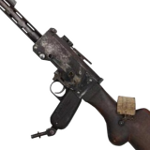
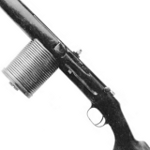
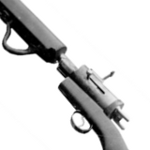
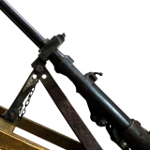
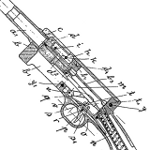
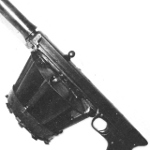
(Photo: Museo Storico Italiano della Guerra)
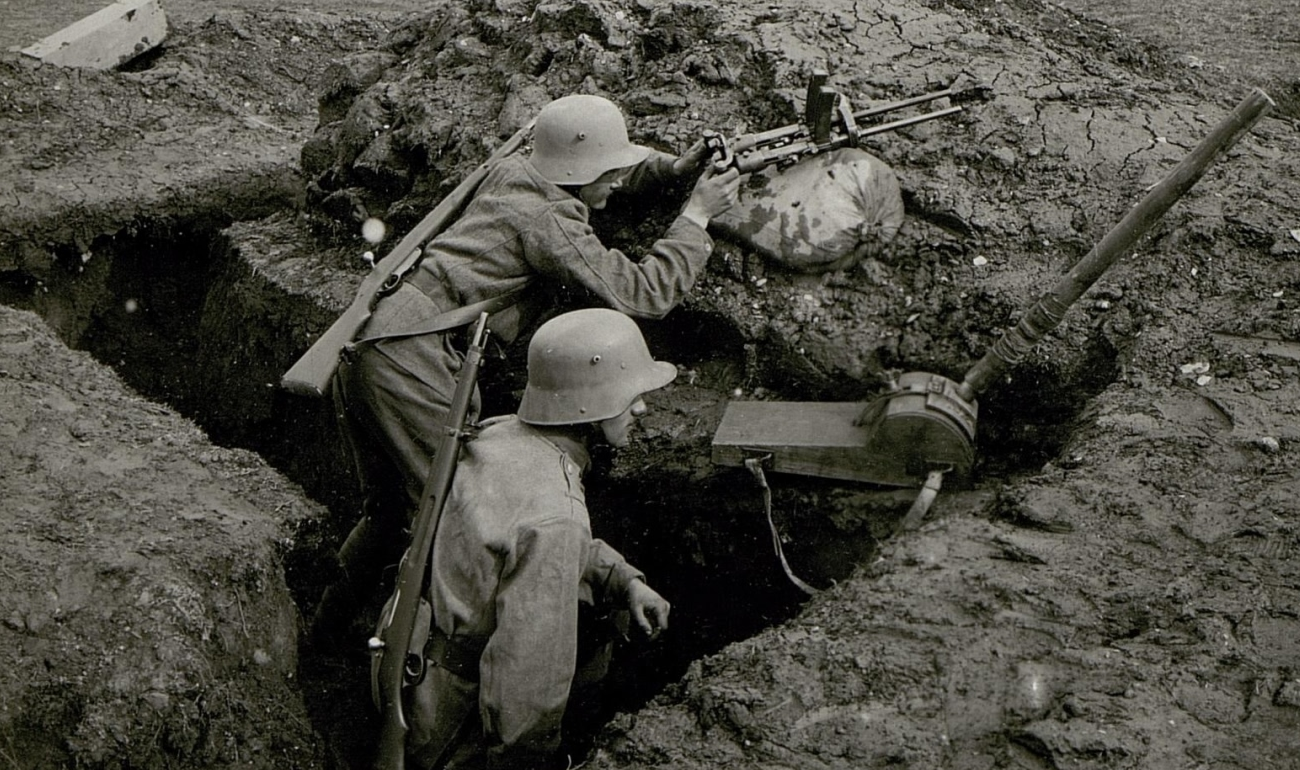
The Austro-Hungarians first encountered the Italian 'pistola mitragliatrice' - the Villar Perosa machine pistol - at the Battle of Asiago (15th May - 27th July 1916). Although only a few hundred Villar Perosas were in frontline service initially, the number swelled up to almost 1,000 guns by the end of the year and it became increasingly common for Austro-Hungarian troops to come under attack from Italian troops wielding this new and unusual weapon. The Austro-Hungarians had already conducted tests of a similar weapon as early as October 1915, the Maschinengewehr Hellriegel, designed by a member of a Tyrolean Standschützen-Battalion (possibly the Meran battalion). But for whatever reason, either because the weapon had not produced the desired results during trial or because there was simply no demand for a machine pistol-type weapon at that time, this proposal was never seriously considered for adoption, nor revisited when the demand did appear.

The
first tests of a captured Villar Perosa, initially and incorrectly
assumed to be a French design, were conducted at the K.u.K.
Artilleriearsenal in Vienna on the 11th July 1916. This weapon, along
with six other examples, had been captured by the 16. Korps (5. Armee)
at the Asiago during the spring of that year. The opinion of the
Villar Perosa from the Austro-Hungarian troops on the front was
positive and the 5. Armee-Oberkommando suggested that production and
adoption of a similar weapon should be undertaken within 2 - 3 months.
Meanwhile the K.u.K.
Kriegsministerium (Imperial & Royal Ministry of War), who
were hesitant to disrupt the production of existing war materials at
the major arms factories, consulted the Ferlach Gunsmiths Cooperative
to determine the feasibility of such a project.
By
November 1916 the Kriegsministerium had become convinced of the merits
of introducing a machine pistol into Austro-Hungarian service.
Initially a request was made to the Österreichische
Waffenfabriksgesellschaft (ŒWG) in Steyr for such a weapon, followed
shortly afterward by the Fegyver-
és Gépgyár (FÉG) of Budapest. The designs by by
ŒWG and FÉG - known as the Anschlagpistole
M.12 and Pistolen-M.G. M.17
respectively - centered around the idea of tethering two independent
automatic pistols together onto a central mount to mimic the Villar
Perosa on a conceptual level, but they bore no similarity to the
Italian weapon on a technical basis. Meanwhile, a sample of the Villar
Perosa was provided to the Škodovy
závody (Škoda) of Plzeň for study, and within only a few months Škoda had successfully built two
reverse-engineered copies of the Italian weapon, which became known as
the Sturmpistole
('Assault Pistol').
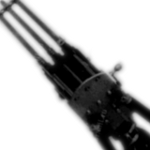
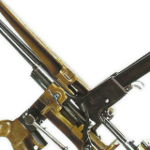
The Sturmpistole was, in most aspects, a direct copy of the Villar Perosa, consisting of twin tubular receivers joined together by a pair of spade grips fitted to their rear. It operated on a delayed-blowback action in which the two bolt faces were rotated by 45° inertial cams in the front part of the cocking slots, to ensure the bolt was fully closed before the firing pin came forward into the chamber and prevent out-of-battery discharges. However the chambering was changed from the Italian 9x19mm Glisenti pistol cartridge to the Austro-Hungarian service 9x23mm Steyr cartridge, the same type used in the M.12 pistol. The vertical magazines, which fed from the top of the receivers, contained 22 rounds each rather than the 25-round capacity of the original Villar Perosa magazines, and were straight rather than curved so as to accommodate for the Austro-Hungarian cartridge. The magazine feeds were based on those of the early pattern Villar Perosa; that is, the magazine housings rotated clockwise to lock the mags in place and anti-clockwise to release them. It should be noted that in later versions of the Villar Perosa, this magazine release system was replaced by a simpler spring-loaded release catch, however the Austro-Hungarians never adapted this idea. The Sturmpistole also did not replicate the Villar Perosa's mounting system, which consisted of a circular disc unit attached to the barrels which slotted into a socket on a large, twin-legged metal shield; rather, it was mounted by a hinge to a proprietary flat wooden pannier with a pair of canvas straps which allowed it to be carried on the user's back. This type of wooden pannier mount was also employed by the Austro-Hungarians for the Schwarzlose M.17 Handmaschinengewehr and for ammunition boxes. A detachable shield was still a feature, but was slotted onto the gun via a pair of diagonal cuts on the sides of the front sight block.


Tests of these two Sturmpistole
prototypes were conducted at the K.u.K. Artilleriearsenal in Vienna
in March 1917, but performed poorly and were sent back to Škoda for refinement. Meanwhile, over
the spring of 1917, the ŒWG
and FÉG machine pistols
were subjected to field testing at the front to determine their
viability. The FÉG
project was rejected due to the lacklustre performance of the
weapon, while the ŒWG
machine pistol fared better but the disruption that it would have
caused to existing production of the Selbstladepistole M.12 and
other war materials produced at Steyr made it unattractive in the
eyes of the Kriegsministerium. Despite its initial
troubles, the Sturmpistole now appeared to be the most promising of
the three projects, and on the 25th of July 1917 the
Kriegsministerium decided to cancel all work on the ŒWG
machine pistol in favour of allocating further funding to Škoda. By September 1917 an improved
model of the Sturmpistole had been completed and was subjected to
fresh tests at Maribor, and a trial batch of 50 guns were delivered
to the Austro-Hungarian Army for field testing on the Italian Front.
As
per other automatic weapons in Austro-Hungarian service,
distribution of the Sturmpistole was dictated by the formation of a
specialist unit which would be trained and issued with these guns.
The unit conceived for the Sturmpistole was known as the
Sturmpistolenpatrouille ('Storm-pistol patrol'). The composition of
the Sturmpistolepatrouille was markedly different from the
platoon-sized sezione pistole
mitragliatrici in the Italian Army.
The
Sturmpistolenpatrouille comprised 4 men: 2 gunners and 2 ammunition
carriers. In the instructional manuals for the Sturmpistole, there
is no mention of a section leader, non-commissioned officer, or
commissioned officer being assigned to the Sturmpistolenpatrouille.
| Personnel |
Rank |
Armament |
Other
equipment |
| 2 Pistolenschütze |
Mann (Private) |
Sturmpistole M.18 ×12 magazines (264 rounds) |
×2 Sturmpistole magazine
pouches ×12 Sturmpistole magazines (264 rounds) |
| 2 Munitionsträger |
Mann (Private) |
Repetiergewehr M.95 x8 clips (40 rounds) |
×2 Sturmpistole magazine
pouches ×16 Sturmpistole magazines (952 rounds) |
One
Sturmpistolenpatrouille was intended to be assigned to each infantry
and dismounted cavalry platoon. As the Sturmpistolenpatrouille
itself had no specially assigned leader, they officially fell under
the command of the company Handmaschinengewehr-Zug
(Light machine gun platoon); if no H.M.G.-Zug existed in the
relevant infantry company, then the Sturmpistolenpatrouille were
subordinate to the Maschinengewehr-Kompanie.
Training
for the Sturmpistole within the relevant infantry company was also
to be directed by the commanding officer of the H.M.G.-Zug or
battalion M.G.-Kompanie. Sturmpistole gunners were trained to
operate the weapon at ranges of 25 - 300 metres, firing from each
barrel sequentially rather than simultaneously. As in Italian
doctrine for the Villar Perosa, disciplined shooting was emphasised
to ensure accuracy and reduce ammunition wastage. In close combat,
troops were instructed to carry the Sturmpistole "on
the arm". Training and familiarisation with the
Sturmpistole was intended to be provided for as many regular
infantry personnel within the company as possible, so that anybody
could be assigned to the Sturmpistolenpatrouille if the
circumstances demanded so, or called upon to replace losses in the
Sturmpistolenpatrouille at short notice. Effectively, it was
conceptualised that every Austro-Hungarian soldier would eventually
become adept in the use of machine pistols.
The
first Sturmpistolen were
delivered to the front on the 10th of October, in anticipation of
the imminent offensive at Caporetto (Karfreit). Small numbers of
guns were assigned to select infantry regiments across the front.
Some of these guns were delivered to the 15. Gebirgsbrigade (50.
Infanterie-Division, attached to the German 14. Armee) stationed in
the Mrzli-Vodil sector, comprising one battalion of the
Infanterieregiment Nr. 18 'Erzherzog Leopold Salvator', one
battalion of the Infanterieregiment Nr. 37 'Erzherzog Rainer', one
battalion of the Infanterieregiment Nr. 61 'Ritter von Frank', and
also elements of the Bosnien/Herzegowina Infanterieregiment Nr. 1.
Almost
immediately after their distribution to the 15. Gebirgsbrigade, the
Italian 2ª Armata (2nd Army) was made aware of the existence of the
Sturmpistole through a pair of Czechoslovak deserters on the 21st
October, who also disclosed details of the imminent offensive. A
bulletin issued by the Commando 2ª Armata on the 21st October 1917
described the recent arrival of the Sturmpistole to the front:
"The battalion is currently in line on
the front between the eastern slopes of Mrzli and Trucchetto Vodil
[...] On the 10th day of this
month, machine pistols were distributed to each squad
(sturm-pistole). These weapons are identical to the Italian ones
but the breech, instead of being made of brass, is made of cast
iron; they performed poorly because out of the nine that arrived,
only one worked."
The
Battle of Caporetto (24th October - 19th November 1917) commenced
three days later, and during the opening hours of the offensive, the
II. Bataillon of IR 18 attacked and captured the village of Gabrje,
probably employing their new Sturmpistoles, thus paving the way for
the German 12. Infanterie-Division to break through the Italian
lines in this sector. Assuming that the weapons recently delivered
to the II./IR 18 were indeed deployed during the offensive, the
fighting at Gabrje was likely the first instance of the
Sturmpistole's use in combat.
Another
participatory unit of this field testing phase is revealed in a
K.u.K. Pressquartier photograph taken on the 25th of October 1917,
the second day of the offensive, depicting a Sturmpistolenpatrouille
of Gebirgsschützenregiment
Nr. 1 (formerly
known as Landwehr-Infanterieregiment Nr. 4
before 1917). Forming part of the 44. Schützen-Brigade (44.
Schützen-Division),
the G.SchR.
1 was stationed at the Carso Plateau with the 1. Isonzo-Armee,
further south from the main offensive at Caporetto.
The G.SchR. 1 experienced heavy fighting in November, spearheading the Austro-Hungarian advance toward Treviso, and on the 12th of November they became the first and only Austro-Hungarian regiment to briefly cross the river Piave, establishing a bridgehead at the village of Zenson di Piave. After suffering substantial casualties attempting to hold their position from Italian counterattacks, the 44. Schützen-Division was relieved by the 48. Infanterie-Division on the 15th November.
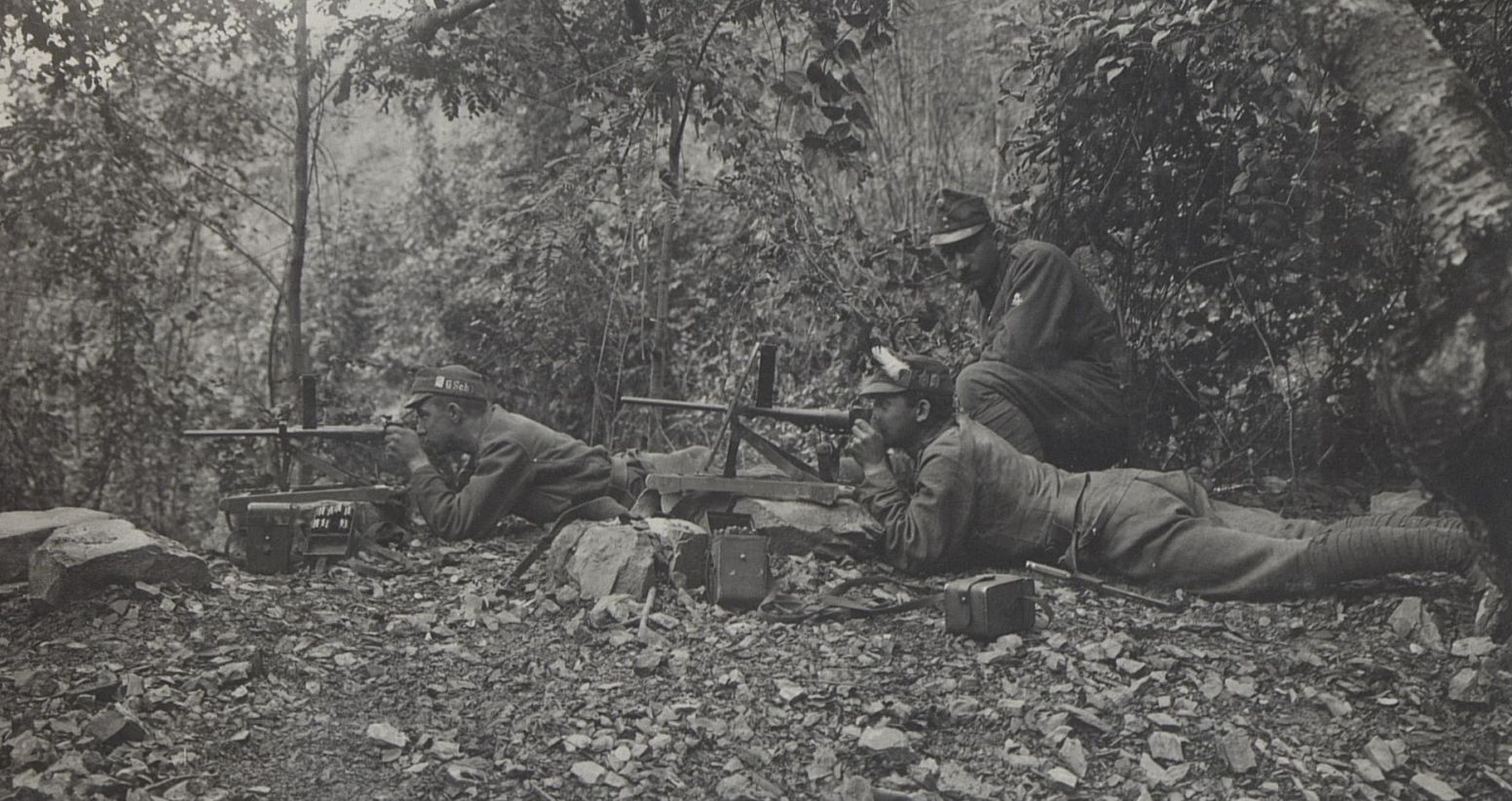
Sturmpistolepatrouille
of the Gebirgsschützen-Regiment
Nr. 1 (Landwehr-Infanterie-Regiment Nr. 4), 25th October 1917.
Note the magazine pouches
containing eight spare magazines each. The Sturmpistole on the
right is fitted with a gun shield.
(Austrian
National Library)
Thus, during the period of October - December 1917, the small number of Sturmpistoles that had been delivered to the front likely saw significant combat use, though due to problems of reliability and lack of ammunition, it was reported that some of the recipient troops in fact swapped out their Sturmpistoles with captured Villar Perosa machine pistols, which were in great abundance following the collapse of the Italian 2ª Armata (official Italian sources estimated some 2,000 guns captured by the Austro-Hungarian and German forces at Caporetto). Feedback from these field tests reported many of the same issues that had already been highlighted in earlier trials, with complaints being leveled at the quality of the magazines and magazine feeds, as well as the detachable gun shield.
At the end of 1917, the Kriegsministerium ordered a further 200 guns from Škoda. In early 1918, proceedings were briefly interrupted by the consideration given to a German machine pistol design, the Maschinenpistole Schwarzlose, which was envisaged as a collaborative project between the K.u.K. Kriegsministerium and their German counterparts in Prussia, with the Schwarzlose design being licensed to ŒWG. However, after the Schwarzlose company failed to deliver on promised trial weapons, the MP Schwarzlose was cancelled in March and the Kriegsministerium now refocused all of their attention to the Sturmpistole. Unfortunately, production of the Sturmpistole was not faring much better; by March 1918, only 85 guns had been delivered, and it became clear that Škoda was struggling to meet even small orders for this new weapon.
Undeterred,
the Kriegsministerium placed an order for 40,000 guns, to be
manufactured across three factories: the
Škoda-Werke in Plzeň,
Fegyver- és Gépgyár in Budapest, and the Waffenhauptfabrik
(WHF) in Vienna. This wildly ambitious target was never realistic in
light of the previous failures to deliver on small batches and was
quickly amended to 20,000 guns, though even this was beyond the
capabilities of any of the three factories, who were suffering from
shortages of materiel, manpower, and food. By May, about 138 guns
had been completed at Škoda
and delivered to the Armee-Schießschule
(Army Shooting School) in Bruckneudorf, where a training course for
the Sturmpistole was established. Further improvements were made to
the design as a result of feedback accumulated during this course,
and study samples of an improved pattern model were sent to the
three contracted manufacturers, with the intent that all existing
production (to the extent that it existed at all) was to switch over
to this new type. The improved pattern model of the Sturmpistole was
better received than the original type.
Despite the limited output of these guns, some were delivered to the front during the last months of the war. Leutnant Otto Gallian of the Sturmbataillon Nr. 4 (4. Infanterie-Division) reported in his memoir Monte Asolone 1918 that his battalion had raised a 'maschinenpistole-zug' ('machine pistol platoon') around June 1918, which is likely a reference to a collective formation of several Sturmpistolenpatrouille. Furthermore, the memoirs of the Infanterieregiment Nr. 94 'Freiherr von Koller' (29. Infanterie-Division) record that a Sturmpistole section was assigned to the regiment's 4. Kompagnie in August 1918. The Kaiserjäger-Sturmbataillon (Kaiserjäger-Division) was issued with Sturmpistoles while stationed at San Sebastiano in September. During this time the battalion was engaged in rearguard policing duties against mutinous Austro-Hungarian units.
Upon deployment during 1918, some of these guns were referred to under the designation 'Sturmpistole M.18'; though Mötz & Schuy note that this was an unofficial designation, much like the Steyr Selbstladepistole M.12. Despite the large number of units ordered and the official use of these guns, there is no record that the Sturmpistole was ever given a formal designation by the Austro-Hungarian Army.
By October 1918, with the Austro-Hungarian war effort collapsing and the war nearing its end, the Kriegsministerium appears to have realised the impossibility of attaining any more than a few hundred guns, and officially postponed all production of the Sturmpistole. The project was permanently abandoned upon the signing of the Armistice of Villa Guisti on the 3rd of November 1918. Mötz & Schuy estimate that only around 250 guns were ever completed, overwhelmingly at Škoda; there is only record of three guns being fabricated at the WHF in Vienna, and there is no record that FÉG ever made any guns at all.
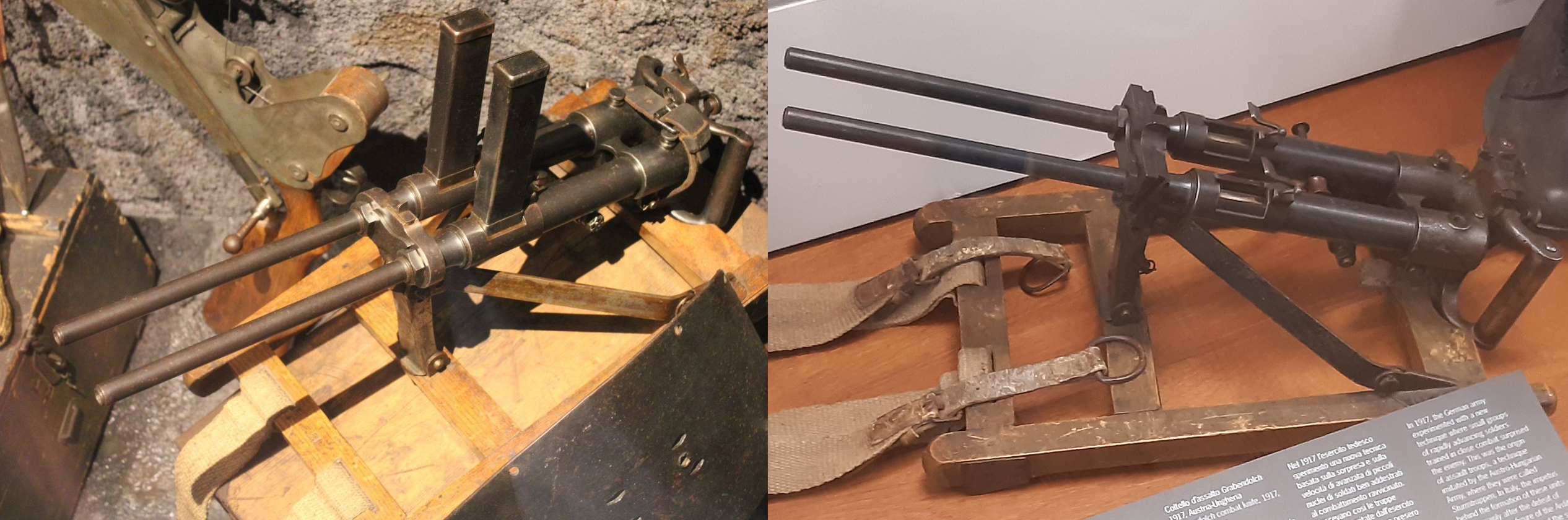
It should be noted that there exists
two different variations of the Sturmpistole
which exhibit detail changes. The primary difference between these
two models, which are herein referred to unofficially as the 'early'
pattern and 'late' pattern, is in the design of the front and rear
sight pieces. The presumed 'early' pattern has a rounded front sight
piece which cannot mount a gun shield. Also in this model, the rear
sight design of the Villar Perosa is retained, incorporating a small
aperture sight bored into the centre of the safety switch at the
rear of the spade grips. The sights cannot be adjusted for different
range graduations. The spherical cocking handles also adhere to the
original Italian type.
The 'late' pattern Sturmpistole incorporates more original design features which deviate from those of the Villar Perosa. The front sight block is rectangular in shape with two diagonal cuts on either side, for a gun shield to be mounted onto. The aperture sight of the Villar Perosa and 'early' pattern Sturmpistole is abandoned in favour of an adjustable open notch rear sight which has several stages of graduation. The safety switch is mounted to the side of the sight unit instead of in front. The cocking handles are tubular instead of spherical, and enlarged in size.
Of
the two variants, it appears that the 'late' pattern was produced in
greater numbers, and is the type illustrated in the official manual.
| Collection | Location | Notes | Condition |
| Heeresgeschichtliches Museum |
Vienna, Austria | Early
pattern model, serial № 18 |
Appears good |
| Sabotin Park Miru | Nova Gorica, Slovenia | Early pattern model | Poor |
| Museo Storico Italiano della Guerra | Rovereto, Italy | Late
pattern model, serial № 194 |
Appears good |
| Museo Nazionale di Castel Sant'Angelo | Rome, Italy | Late pattern model | Appears good |
| Museo della Bonifica | Venice,
Italy |
Late pattern model | Extremely poor |